


  1. Posts/

Strong Geomagnetic Storm on May 29th

·1 min·
Notaspampeanas
Corotating Interaction Region Solar Wind Geomagnetic Storm Auroras
Notaspampeanas
Author
Notaspampeanas
Digging on curiosity and science.

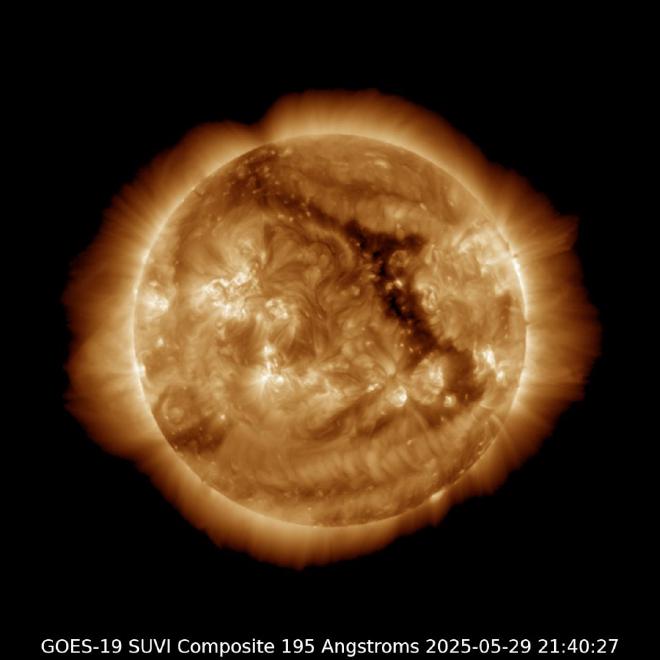
As on May 2024, now on May 29th, we have had a strong geomagnetic storm. A year ago with a cannibal solar storm, today with another surprise strong geomagnetic storm during the early hours of May 29th, as SpaceWeather.com informed in the website.

An image taken on May 29th by GOES Solar Ultraviolet Imager
An image taken on May 29th by GOES Solar Ultraviolet Imager (SUVI)

“MORE STORMS ARE POSSIBLE TODAY: Earth’s magnetic field is still reverberating from the impact of a CIR, which produced a strong geomagnetic storm during the early hours of May 29th. The storm is subsiding now, but it might not be over. NOAA forecasters say that minor (G1) to moderate (G2) storms are possible in the hours ahead”, said SW. You can access to the SMS Text Aurora Alerts

The website founded by Dr. Tony Phillips explained that “a co-rotating interaction region (CIR) hit Earth on May 29th, sparking a strong G3-class geomagnetic storm with auroras in both hemispheres.

“CIRs are transition zones between fast- and slow-moving streams of solar wind. They contain CME-like shock waves that do a good job sparking geomagnetic storms and auroras. We knew this CIR was coming, but expected it to produce no more than a minor storm. The G3 strength of the storm was a surprise to forecasters”, we can read on SpaceWeather.com.

Related

Nosotros
·1 min
Ricardo Daniel González Guinder
Us
·1 min
Ricardo Daniel González Guinder
Taking a Close Look at an Asteroid
·4 mins
Notaspampeanas
Asteroids Apophis Julius-Maximilians-Universität Würzburg NEAlight Project
Sunlight unlocks secrets to how Earth works
·3 mins
Notaspampeanas
Sun Earth Solar Radiation Sunlight
Soccer Players Risk Heat Stress in 2026 World Cup Stadiums
·7 mins
Notaspampeanas
Climate Change Global Warming Sports Soccer 2026 FIFA World Cup
Shrinking Andean glaciers threaten water supply of 90 million people
·4 mins
Notaspampeanas
Glaciers Andean Glaciers Climate Change Mitigation Water Supply Carbon Emissions Climate Policy