


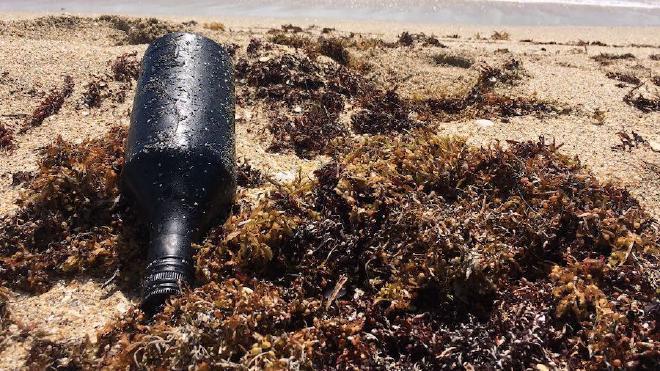
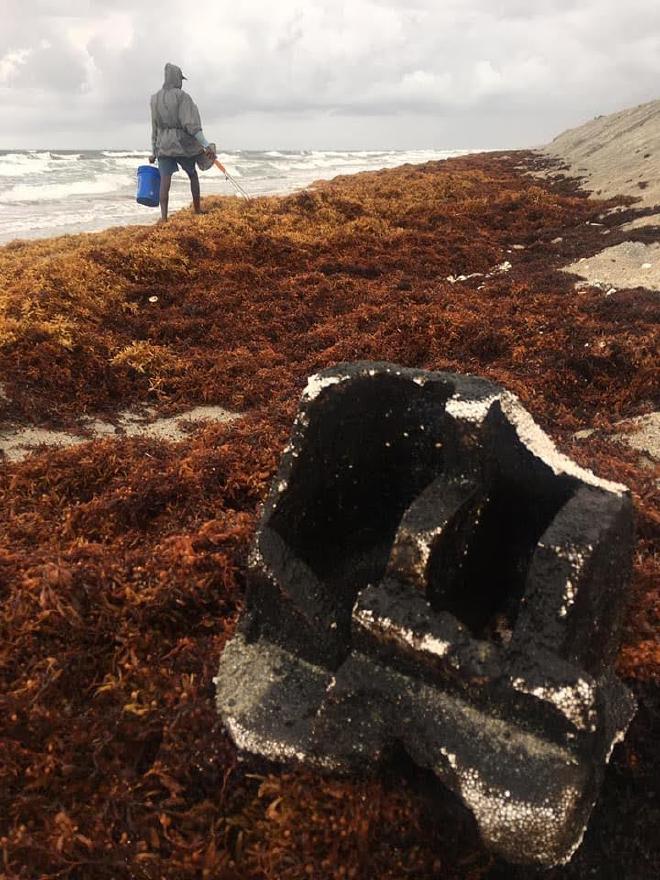
No oil spills had been reported locally, and the high amount of residue-coated debris created a mystery: Where was all this black sludge coming from?
Christopher Reddy, a chemical oceanographer at the Woods Hole Oceanographic Institution, had been working with an international team of scientists on a separate mystery: the origins of a 2019 oil spill in Brazil, the largest in the country’s history. When he saw the debris posted on the Friends of Palm Beach Instagram page, he reached out. “I was like, ‘Please, please send [the debris] to us,’” he said. The details Buhler was providing about the debris, he said, were “remarkably informative.”
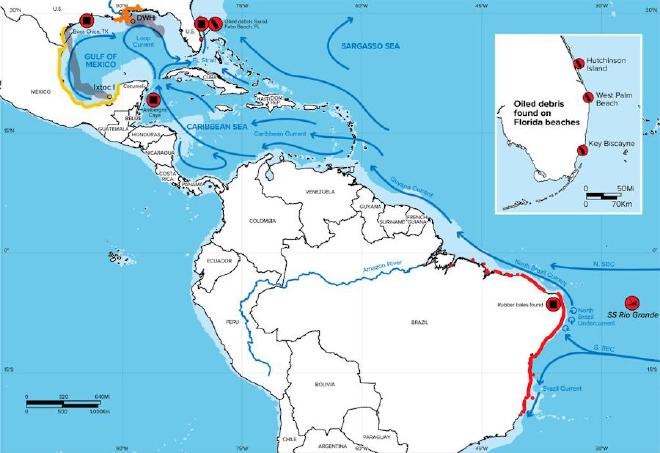
Reddy and the team had a hunch: They thought the 2020 Florida debris and the 2019 Brazil spill were linked. Because of weathering, oil residues rarely travel more than 300 kilometers (186 miles)—but perhaps they’d used plastic pollution to hitch a ride to the Sunshine State.
A thorough analysis, published in Environmental Science and Technology, confirmed the residue likely originated from the Brazil spill. The findings reinforce scientists’ hypothesis that oil can travel far greater distances when attached to plastic debris in the ocean.
Matching Mysterious Oil Samples #
“This project wouldn’t have happened unless there was this knowledge of the way the currents move,” said Reddy, a coauthor on the new study.
The team was astounded at the similarities, particularly the chromatography results. “It was such crystal-clear evidence that I got nervous,” Reddy said. “Oh my gosh, this really did happen,” he remembered thinking.
The data are “pretty striking,” agreed Bryan James, a chemical engineer at Northeastern University and coauthor on the new study.
The authors think it’s likely that similar debris washed up on Caribbean shores as well as Florida’s but simply wasn’t collected or cataloged. “Southeast Florida was where there was a person thinking and looking, who had this database in her head” and reported it, too, Reddy said.
While the “science is solid,” Boufadel said, additional evidence from elsewhere in the Caribbean would add confidence to the results.
A Plastic Problem #
James said this raises a colocation problem. Many sources of oil and sources of plastic overlap, creating a “greater possibility for these two to find each other…and continue to move oil farther from where it originated,” he said.
The results are further proof of a known risk of plastic pollution: It can be a vector for other toxic substances, Boufadel said.
Colleagues in Brazil, Reddy added, are continuing to investigate the origin of the still-mysterious 2019 spill there, as well. It may be oil that leaked from the SS Rio Grande, a German* supply boat sunk by the U.S. Navy in 1944, but more research is needed to confirm that hypothesis, Reddy said.
Citation #
—Grace van Deelen (@gvd.bsky.social), Staff Writer
Citation: van Deelen, G. (2026), Plastic debris helps oil residues reach farther across the ocean, Eos, 107, https://doi.org/10.1029/2026EO260033. Published on 20 January 2026. Text © 2026. AGU. CC BY-NC-ND 3.0 Except where otherwise noted, images are subject to copyright. Any reuse without express permission from the copyright owner is prohibited.
- The study Long-Range Transport of Oil by Marine Plastic Debris: Evidence from an 8500 km Journey was published in Environmental Science & Technology. Authors: Bryan D. James, Luis E. A. Bezerra, Diane Buhler, Rivelino M. Cavalcante, Martha L. Aguilera, Bing Chen, Jonas Gros, Ulrich M. Hanke, Karin L. Lemkau, Robert K. Nelson, Sydney F. Niles, André H. B. de Oliveira, Thomas D. Pitchford, Jagoš R. Radović, Ryan P. Rodgers, Marcelo O. Soares, Scott A. Socolofsky, Roger E. Summons, Robert F. Swarthout, Carlos E. P. Teixeira, David L. Valentine, Helen K. White, Min Yang, Eliete Zanardi-Lamardo, Baiyu Zhang & Christopher M. Reddy
Contact [Notaspampeanas](mailto: notaspampeanas@gmail.com)