


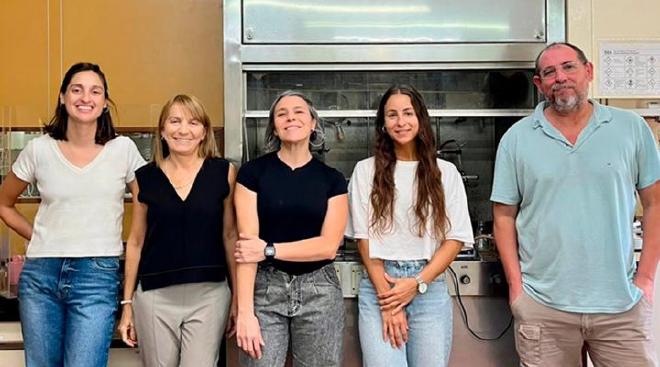
“When recycling ceases to be just a good intention and becomes a technically and economically viable alternative, it can generate positive environmental impact, economic value and social benefits, transforming an environmental problem into a productive opportunity,” Gilbert said, who for her most recent project entitled ‘Chemical recycling of plastics’, was the winner of the Franco-Argentine Innovation Distinction in the Junior category.
A race against pollution #
Gilbert oriented his research towards plastic pollution as soon as he entered the scientific career. Previously, she had studied the generation of new ‘polybenzoxazines’: thermoset materials with good thermal, physical and chemical properties. She also worked on the development of quaternary ammonium disinfectants similar to commercial ones, which are effective against viruses, bacteria and fungi, but are toxic to the environment. In this case, the strategy was based on incorporating a carbonate group that allows the surfactant to degrade into choline – an essential nutrient – and a natural alcohol, both biodegradable, after consumption.
Until now, the chemical recycling methods available on the market required high temperatures and pressures, long reaction times, the use of inert atmospheres, microwaves and expensive catalysts or complex preparation. What Gilbert and his team managed to solve these difficulties was to use an accessible, non-polluting organic catalyst. As the researcher explained: “Using depolymerizing agents derived from biomass, we developed methods that, at low temperature and pressure and in short times, managed to completely depolymerize polycarbonate waste. This process allows BPA to be recovered avoiding its release into the environment, and to obtain molecules with carbonate functionality of high commercial value, in turn preventing the release of carbon dioxide.”
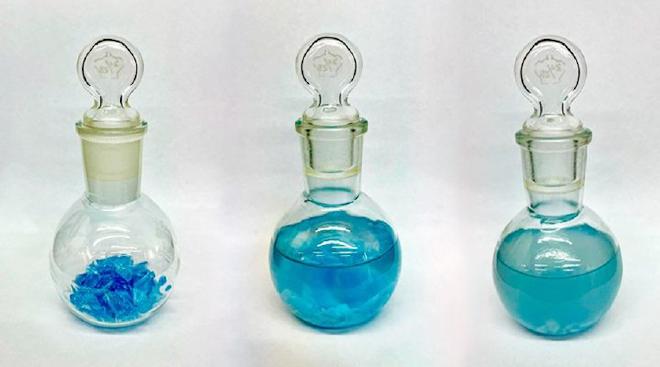
This catalyst allows ‘selective sequential recycling’, optimizing recycling times and solving one of the main problems of current recycling: the fact that the different plastic materials are incompatible with each other, so that, for their reuse, an exhaustive separation and cleaning process must be carried out that demands a lot of time and money, which makes the process less profitable. “Selective sequential recycling consists of a process of controlled chemical depolymerization that takes advantage of the structural differences of the different plastics and, therefore, their reactivity. This process allows a mixture to be selectively recycled from one plastic to one stage (sequential). Thus, by adjusting certain parameters of the recycling process, such as temperature, the nature of the depolymerizing agent or the type of catalyst, it is possible to induce the selective depolymerization of a plastic without affecting the others present in the waste mixture,” explained the scientist.
The scientist is confident that “since the processes are simple, require low initial investment, use low-cost raw materials and involve low energy consumption, plastic waste can be transformed into valuable resources to be reincorporated into production circuits.” She also highlighted that in the future, “as the molecules generated can, within certain limits, be designed, it will be possible to obtain new types of polyurethanes, polyhydroxyurethanes, polycarbonates, epoxy resins, among others. In addition to new materials, the engineered molecules could be used as green (biodegradable) solvents; as precursors of synthesis in the chemical, agro-chemical, pharmaceutical and veterinary industries; or in cosmetic and agricultural formulations.”
The characteristics of the project facilitate its scaling and the technological transfer of the method, which opens the possibility for companies and cooperatives to implement the technology in real contexts. “Our method does not complicate current recycling processes, nor does it require large investments in equipment; it promotes the creation of local employment and new productive opportunities and, ultimately, allows waste to stop accumulating as an environmental problem and become useful inputs, reducing the amount of plastic that reaches landfills and promoting concrete circular economy actions,” she concluded.
Contact [Notaspampeanas](mailto: notaspampeanas@gmail.com)