



  1. Posts/

AGGRESCANAI, a software developed to study proteins associated with Alzheimer's, Parkinson's and other neurodegenerative diseases

·3 mins·
Notaspampeanas
AggrescanAI Leloir Institute Foundation CONICET Alzheimer Parkinson ELA Neurodegenerative Diseases ITBA Art
Notaspampeanas
Author
Notaspampeanas
Digging on curiosity and science.
Table of Contents

‘AggrescanAI’ is a tool developed by specialists from CONICET, the Leloir Institute and ITBA. It surpasses other computer systems that are standard today, is free and can have a direct impact both economically and on public health.

Cristina Marino-Buslje, CONICET researcher at the Leloir Institute Foundation and co-author of the work. Image credit: FIL-Cristina Marino-Busjle

One of the greatest challenges of current medicine is to be able to understand and predict the incorrect folding of proteins and the consequent formation of toxic aggregates in the brain, since it is known that they collaborate in the development of neurodegenerative diseases such as Alzheimer’s, Parkinson’s, or amyotrophic lateral sclerosis (ALS), among others. Now, an international group, led by specialists from CONICET, the Leloir Institute Foundation (FIL) and ITBA, presented a software that uses AI to anticipate the so-called ‘Aggregation-Prone Regions’ more effectively than those currently used.

What is AggrescanAI?
#

“AggrescanAI is a deep learning tool that uses artificial intelligence to predict these regions that drive protein aggregation. Unlike previous tools, which saw proteins as simple strings of letters, our software ‘reads’ the protein in the same way that a human reads a sentence: it understands that the meaning (or behavior) of a part of the protein changes according to what happens around it,” explained Cristina Marino-Buslje, a CONICET researcher at the Institute of Biochemical Research of Buenos Aires (IIBBA, CONICET-FIL), head of the FIL’s Structural Bioinformatics Laboratory and co-author of the work published in the Journal of Molecular Biology. The work was carried out in collaboration with the group of Salvador Ventura, from the Autonomous University of Barcelona, and has as its first author Álvaro Navarro, who is doing his doctorate under the direction of the researcher.

Marino-Buslje pointed out that to create the tool they used the ProtT5 protein language (pLM) model, one of the most widely used for its ability to predict and study biological functions. pLMs are artificial intelligences that learn the ’language’ of proteins. To do so, they transform each amino acid into a set of numbers technically called ’embeddings,’ which capture its function and context within the protein. Thus, AI can predict biological properties without seeing the structure, understanding proteins almost as if it were reading their meaning. “In our case, embeddings allow us to predict the region that produces aggregation,” she said.

The creators of the new software believe that it could have a direct impact on both economic and public health, accelerating the development of possible therapies and diagnostics.

“By predicting aggregation based solely on the sequence of the protein, you don’t need expensive and time-consuming 3D imaging to know if the protein is dangerous,” Marino-Buslje said. She added that “diseases such as Alzheimer’s, Parkinson’s and ALS are caused by proteins that accumulate in the brain. AggrescanAI allows those who investigate these pathologies to virtually test which proteins have this tendency and take the first step to be able to investigate thousands of molecules to see which ones best prevent the formation of these aggregates.”
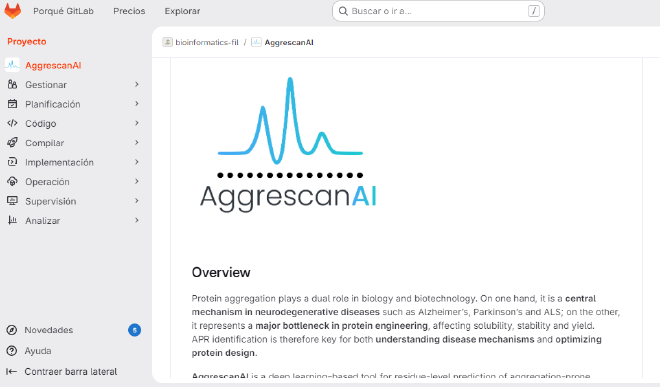
AggrescanAI** can be accessed on GitLab. Image credit: Marino-Buslje et al.
AggrescanAI can be accessed on GitLab. Image credit: Marino-Buslje et al.

On the other hand, the software can predict dangerous genetic mutations – likely to cause protein aggregation – and thus help doctors establish faster diagnoses and plan personalized therapies.

AggrescanAI can be freely accessed through a Google Colab notebook: entering who needs an answer just have to enter the sequence of the unknown protein and press ‘run all’. These simple steps allow the user to get the result and know if it will have areas with a tendency to aggregation or not.

Citation
#

  • The study AggrescanAI: Prediction of Aggregation-Prone Regions Using Contextualized Embeddings was published in the Journal of Molecular Biology. Authors: Alvaro M. Navarro, Santiago Palacios, Thierry Galmarini, Oriol Bárcenas, Salvador Ventura & Cristina Marino-Buslje.

Contact [Notaspampeanas](mailto: notaspampeanas@gmail.com)


Related

Why some volcanoes don’t explode
·5 mins
Notaspampeanas
Volcanoes ETH Zurich
Theia and Earth Were Neighbors
·6 mins
Notaspampeanas
Planetary Science Geochemistry
La Pampa: Comprehensive activities to raise awareness about Diabetes
·4 mins
Notaspampeanas
La Pampa World Diabetes Day
Preclinical Study: Intermittent Light and Sound Stimulation Promotes Development of New Neurons in Aging Brains
·6 mins
Notaspampeanas
Alzheimer Fundación Instituto Leloir Brain Disorders Cognitive Disorders
A case of non-native Influenza A is confirmed in La Pampa
·2 mins
Notaspampeanas
La Pampa Influenza a Virus Ministry of Health
September is Healthy Aging Month
·3 mins
Notaspampeanas
September Healthy Aging Month National Institutes of Health