


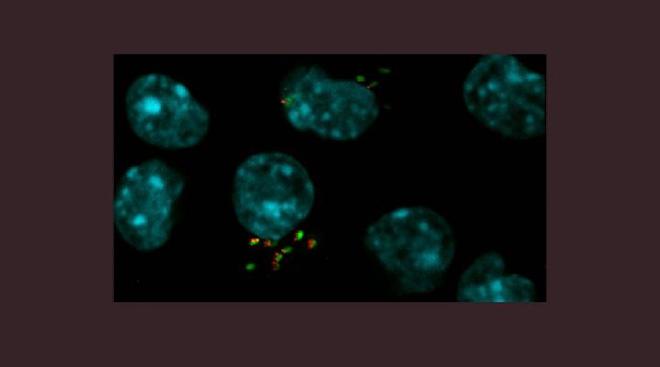
Studies of disease-causing bacteria often focus on understanding how they ‘ignite’ their attack to infect cells. But understanding how to turn it off in time, to avoid wasting unnecessary energy or putting the immune system of the invaded organism on extreme alert, can be just as or more important when what is sought is to achieve interventions that can prevent or slow down its progress.
The group from the Molecular and Cellular Microbiology Laboratory, directed by Angeles Zorreguieta at Leloir Institute Foundation, revealed in Scientific Reports the identification of two proteins from the Brucella bacteria – until then uncharacterized – and suggests that these act as “sensors” of iron and manganese inside the cell, a fundamental role in consolidating the progression of the infection: when they detect the presence of these metals, they send the “turn off” signal to the genes that synthesize other types of proteins called virulence factors, which help the pathogen resist cellular defense.
“The identification of a link between the regulation of metal homeostasis and virulence factors within the cells of the immune system proposes a molecular mechanism of intracellular adaptation for this bacterium,” said Rodrigo Sieira, who together with Zorreguieta led the work that has doctoral fellow Gastón Amato as first author. “This proposed mechanism has potential utility for the design of future strategies to treat acute infections,” Sieira added.

In action #
For the study, the researchers set out to identify the key proteins that control the expression of the bacteria’s virulence genes. To do this, they first used bioinformatics tools to analyze regulatory regions of a group of genes that the bacterium activates when it enters a cell of the immune system. “We looked for those DNA sequences that are repeated there and that led us to the identification of sequences similar to binding sites for transcription factors of the Fur family,” explained Sieira.
The scientists showed that Mur and Fur4, two proteins belonging to the Fur family, turn off the expression of genes essential for Brucella virulence in response to the addition of iron or manganese in bacteria grown in the laboratory. “We saw that Mur and Fur4 turn them off once they are no longer needed, after the bacterium prevented the degradation of the lysosomes and began to replicate in the host cell,” described Sieira. On the other hand, in modified strains of Brucella, which lack Mur and Fur4, the virulence genes are not turned off and remain active, even longer.
“Our experiments suggest that the Mur and Fur4 proteins detect fluctuations in the availability of metals during the transition from a hostile, acidic and nutrient-devoid environment to favorable conditions for replication,” Sieira highlighted. In this way, Brucella represses the expression of specific genes once they have already fulfilled their function, and thus avoids unnecessary energy expenditure in their synthesis and assembly.
Based on the understanding that through the Fur4 and Mur regulators this bacterium would use signals from the environment – the presence of iron and manganese – to decide when to turn on and when to turn off its virulence genes, the scientists would have found a weakness. The challenge, now, will be to see if treatments can be devised that trick those sensors into turning off genes prematurely or never turning them on, giving a crucial advantage to the patient’s immune system’s defense cells.
Citation #
- The study A previously uncharacterized Fur-family metalloregulator integrates iron- and manganese-sensing to control virulence gene regulatory networks in Brucella was published in Scientific Reports. Authors: Gastón E. Amato, Tadeo Pascua, Lila Y. Ramis, Magalí G. Bialer, Angeles Zorreguieta & Rodrigo Sieira
Contact [Notaspampeanas](mailto: notaspampeanas@gmail.com)