


The issue was exposed on an article from de UNC Secretariat of Science and Technology, signed by Lucas Gianre from UNCiencia Editorial Staff
‘Exposure to herbicides in Argentina is a long-standing problem linked to the no-till farming model. Despite the controversy surrounding their use, there is little scientific data on human exposure levels.’
‘The study analyzed samples taken in 2019. The innovative aspect of this work is that, in addition to analyzing urine and blood, the saliva of the volunteers was also studied. The sample (35 people) was divided between agrochemical applicators (15) and people with no work-related contact with the sector (20).’
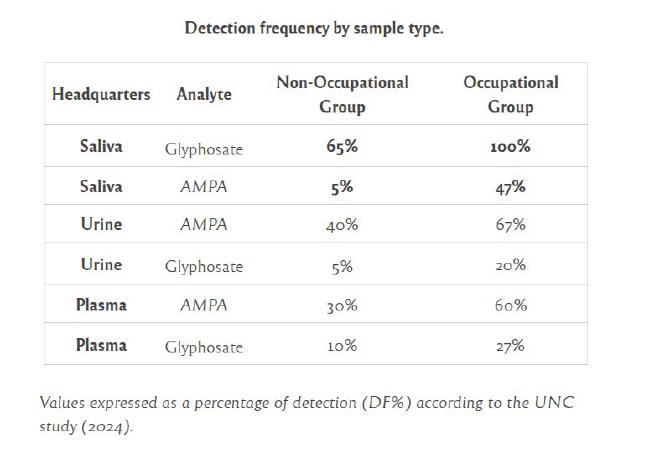
‘The results marked a milestone: it is the first study worldwide to detect concentrations of glyphosate and its residue, aminomethylphosphonic acid (AMPA), in human saliva. In saliva samples, glyphosate was detected in 65% of the non-worker group, while in applicators it reached 100%.’
“In saliva, we found much higher concentrations than in the other studies that evaluated glyphosate in urine and plasma. This wasn’t described anywhere, and there’s still no explanation for why glyphosate is so prevalent there,” Filippi said. She belongs to the Environmental Epidemiology Group of Cancer and other Chronic Diseases in Córdoba (GEACC*) and the Laboratory of Research on Aquatic Pollution and Ecotoxicology (LICAE).
The average concentrations of glyphosate found in saliva were 2.86 ng/ml (nanograms per milliliter) in workers, compared to 0.38 ng/ml in the group without direct exposure. To ensure accuracy, highly complex technology such as gas chromatography coupled with mass spectrometry was used.
A less invasive method #
Glyphosate is the most widely used herbicide in the country. The International Agency for Research on Cancer (IARC) classifies it as “probably carcinogenic to humans” (Group 2A). According to this agency’s assessment, there is “limited” evidence in humans regarding the carcinogenicity of glyphosate. A positive association with non-Hodgkin lymphoma has been observed. Meanwhile, in animals, the evidence is “sufficient.”
However, Filippi clarified that this study is descriptive and functions as a “snapshot” and indicates that both workers and the general population are exposed to the contaminant. “We cannot say what effect this will have on the health of the people in whom the pesticide was detected based solely on this analysis; further studies are needed. It is a sensitive issue; we are concerned about the health of the population and, especially, that of the applicators due to their greater exposure.”
The researcher acknowledged that, although regulations in Córdoba have progressed and, for example, require minimum distances for spraying, these limits remain a challenge on inland towns. This new method, which involves determining glyphosate exposure in saliva, will make it much easier and more direct to monitor the health of the population.
Institutions #
Institute for Research in Health Sciences (Inicsa) of the Faculty of Medical Sciences of the UNC and Conicet; Institute of Environmental Diagnosis and Water Study (IDAEA, CSIC) in Barcelona, Spain; School of Nutrition (Faculty of Medical Sciences of the UNC) and Center for Research in Clinical Biochemistry and Immunology (Cibici) of the Faculty of Chemical Sciences of the UNC and Conicet.
Citation #
-
The study Glyphosate and AMPA in saliva and other traditional human matrices. New findings for less invasive biomonitoring to the exposure to pesticides. was published on Environmental Advances from ScienceDirect group. Authors: Iohanna Filippi, Pilar Fernández, Joan O. Grimalt, Mariana Butinof, María V. Amé & Sonia E. Muñoz
-
The article Detectan glifosato en saliva de aplicadores y vecinos de una ciudad agrícola de Córdoba, signed by Lucas Gianre was published in agronomy’s section on unciencia’s website
Contact [Notaspampeanas](mailto: notaspampeanas@gmail.com)