


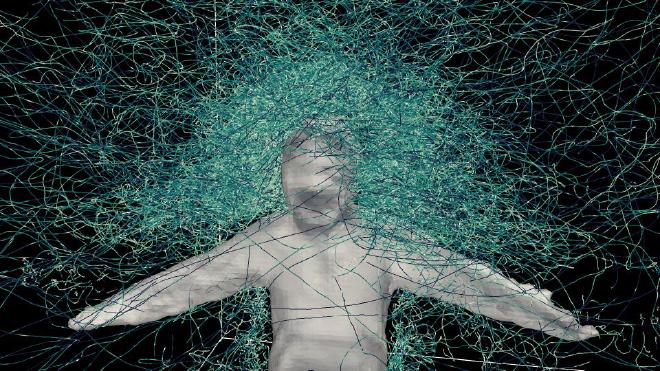
The new study is the first to visualize mosquito flight patterns and provides hard data for improving capture and control strategies. In addition to being a nuisance, mosquitoes transmit diseases such as malaria, yellow fever, and Zika, which cause more than 700,000 deaths every year.
The team used 3D infrared cameras to see how the insects moved around inanimate objects based on visual cues and carbon dioxide. Then they put a person in a chamber, dressed him in various shades of clothing, and tracked mosquito trajectories.
The study was published in Science Advances and focused on female Aedes aegypti mosquitoes (also called yellow fever mosquitoes), which are found throughout the southeastern United States, California, and around the world.
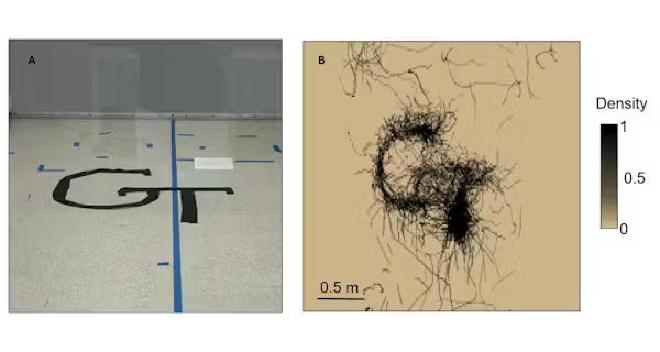
“It’s like a crowded bar,” said David Hu, a professor in Georgia Tech’s George W. Woodruff School of Mechanical Engineering and the School of Biological Sciences. “Customers aren’t there because they followed each other into the bar. They’re attracted by the same cues: drinks, music, and the atmosphere. The same is true of mosquitoes. Rather than following the leader, the insect follows the signals and happens to arrive at the same spot as the others. They’re good copies of each other.”
When the researchers swapped the black target with something white and added carbon dioxide, mosquitoes slowly found the source, but only if they were nearby. Hu noticed the insects doing a “double take” before settling in around the source.
“Previous studies had shown that visual cues and carbon dioxide attract mosquitoes. But we didn’t know how they put those cues together to determine where to fly,” said Christopher Zuo, who conducted the study as a Georgia Tech master’s student. “They’re like little robots. We just had to figure out their rules.”
Zuo stretched out his arms and let dozens of insects circle him as cameras captured their trajectories. The data was sent to MIT, which determined the mostly likely rules that generated those flight patterns.
The yellow fever mosquitoes flew around Zuo just as if he was an inanimate object. The biggest swarms were around his head and shoulders, the species’ typical attraction points.
Luo wore a long-sleeved sweatshirt, pants, and head covering in the chamber. He said he wasn’t bitten very often.
The researchers hope their findings can lead to better pest control.
“One tactic is using suction traps that rely on steady cues, such as continuous CO2 release or constant light sources, to attract mosquitoes,” Zuo said. “Our study suggests using them intermittently, then activating suction at intervals, might be better. That’s because mosquitoes don’t tend to stick around their target when both clues aren’t used at the same time.”
Citation #
- The study Predicting mosquito flight behavior using Bayesian 1 dynamical systems learning was published in Science Advances. Authors: Christopher Zuo, Chenyi Fei, Alexander E. Cohen, Soohwan Kim, Ring T. Cardé, Jörn Dunkel, and David L. Hu
Hundreds of Hungry Mosquitoes, a Student Volunteer and a Mesh Suit #
“Four minutes is too long.”
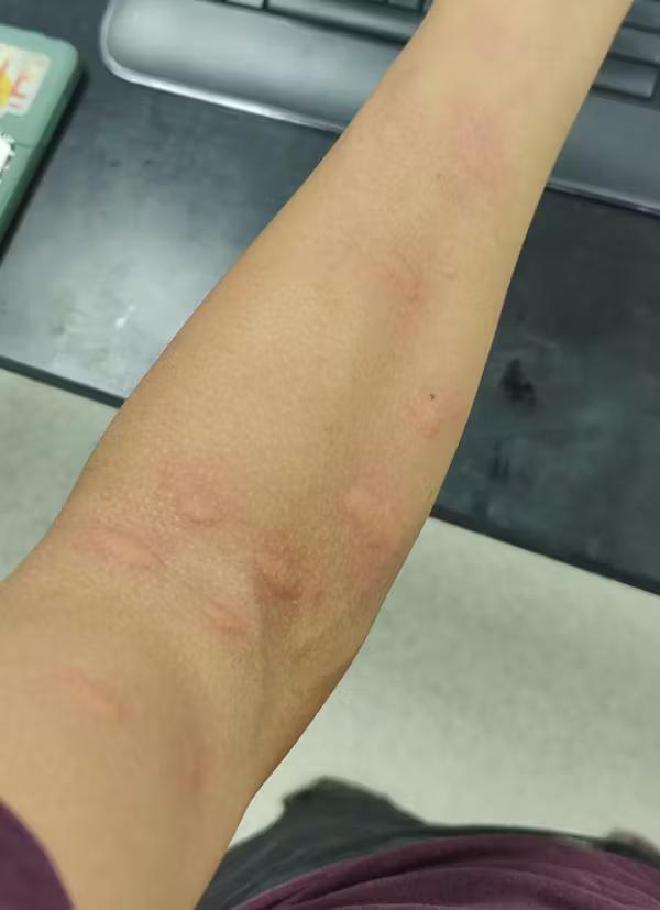
That’s the note undergraduate Chris Zuo sent me -said David Hu, Professor of Mechanical Engineering and Biology, Adjunct Professor of Physics, Georgia Institute of Technology- along with photos of countless mosquito bites on his bare skin. This full-body massacre wasn’t the result of a camping trip gone awry. He’d spent that limited amount of time in a room with 100 hungry mosquitoes while wearing nothing but a mesh suit we thought would have protected him.
Besides my role as torturer of students -added Hu-, I am an author and professor at Georgia Tech with over 20 years of experience studying the movement of animals.
The world spends US$22 billion per year on billions of liters of insecticides, millions of pounds of larvicides, and millions of insecticide-treated bed nets – all to fight a tiny insect that weighs 10 times less than a grain of rice and has only 200,000 neurons.
Scientists know mosquitoes have terrible eyesight and depend on chemical cues to make up for it. Knowing what attracts a mosquito, though, isn’t enough to predict its behavior. You can know a heat-seeking missile is drawn to heat, but you still won’t know how a missile works.
How Mosquitoes Zero In On Their Meal #
Out of 3,500 species of mosquitoes, over 100 species are classified as anthropophilic, meaning they prefer humans for lunch. Certain species of mosquitoes will find the one person among a whole herd of cattle in order to suck human blood.
Carbon dioxide, the byproduct of respiration of all living animals, is particularly attractive. Mosquitoes notice carbon dioxide as well as you notice the stink of a full dumpster, detecting it up to 30 feet (9 meters) away from a host, where concentrations dip to a few parts per million, like a few cups of dye in an Olympic-size pool.
Mosquitoes’ vision isn’t much help as they hunt for their next blood meal. Their two compound eyes have several hundred individual lenses called ommatidia, each about the width of a human hair. They produce a somewhat blurry mosaic or pixelated image. Due to the laws of optics, mosquitoes can discern an adult-size human only at a few meters away. With their vision alone, they cannot distinguish a human from a small tree. They inspect every dark object.
Gathering the Flight-Path Data #
The challenge with studying mosquito flight is that, like trash-talking teenagers, most of what they do is meaningless noise. Mosquitoes flying in an empty room are largely making random changes in flight speed and direction. We needed many flight trajectories to cut through the noise.
One of our collaborators, University of California, Riverside, biologist Ring Cardé, told us that back in the 1980s, scientists conducted “bite studies” by stripping down to their underwear and slapping the mosquitoes that landed on their naked bodies. He said nudity prevented confounding variables, such as the color of a shirt’s fabric.
Instead, Chris washed long-sleeved clothes in unscented detergent and wore gloves and a face mask. Fully protected, Chris only had to stand and wait, while a cloud of mosquitoes swarmed him.
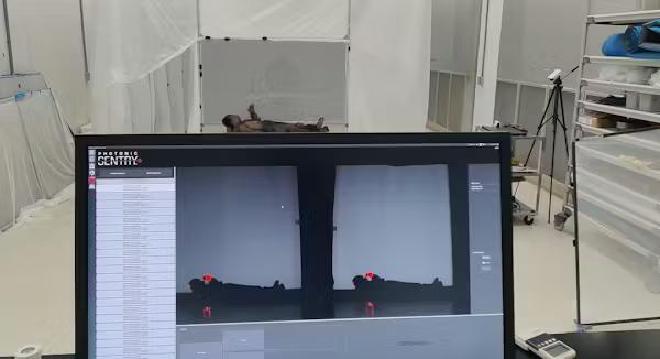
The U.S. Centers for Disease Control and Prevention introduced us to the Photonic Sentry, a camera that simultaneously tracks hundreds of flying insects in a room. It records 100 frames per second at 5 mm resolution for a space like a large studio apartment. In just a few hours, Chris and another graduate student, Soohwan Kim, generated more mosquito flight data than had previously been measured in human history.
100 mosquitoes flying around Chris Zuo for 10 minutes. Only a fraction of tracks are shown.
Over the next two years, Chris filmed the mosquitoes circling the Styrofoam dummies mercilessly. Then he vacuumed up the mosquitoes, trying not to get bitten.
Deciphering the Trajectories #
Our confidence in our behavioral rules increased as we read more trajectories, ultimately using 20 million mosquito positions and speeds. This idea of incorporating observations to support a mathematical hypothesis is a 200-year-old idea called Bayesian inference. We illustrated the mosquito behavior we’d observed in a web application.
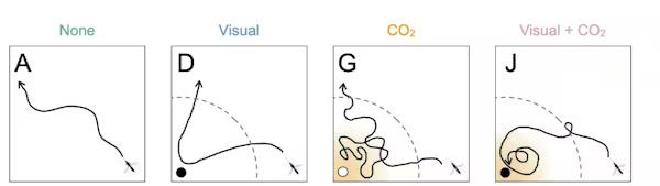
Up until now, we had used only experiments with Styrofoam spheres to train our model. The true test was whether it could predict mosquito flights around a human. Chris returned to the chamber, this time wearing all white clothes and a black hat, turning himself into a bull’s-eye. Our model successfully predicted the distribution of mosquitoes around him. We identified zones of danger, where there was a high chance of a mosquito circling around him.
When Chris’ mother attended his master’s degree defense, I asked her how she felt about her son using himself as bait for mosquitoes. She said she was very proud. So am I – and not just because I’m relieved Chris didn’t ask me to take his place in the mosquito chamber.
This article is republished from The Conversation under a Creative Commons license. Read the original article.
Contact [Notaspampeanas](mailto: notaspampeanas@gmail.com)