


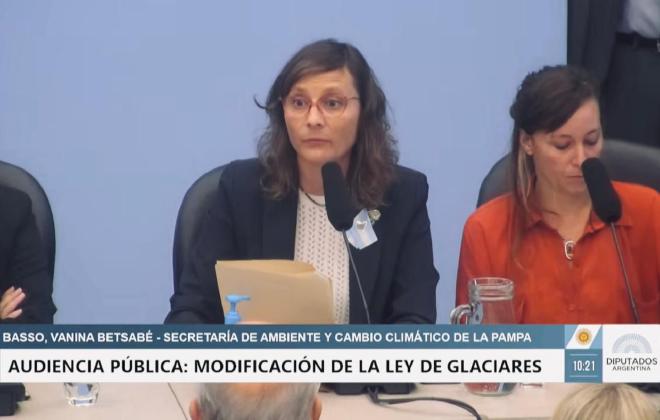
Basso spoke this today in the Chamber of Deputies of the Nation during the public hearing convened to analyze the project to modify the Glacier Law. On behalf of the provincial government, she supported the rejection of the initiative and warned that making the protection of glacial and periglacial environments more flexible puts the water security of the territories located downstream at risk.
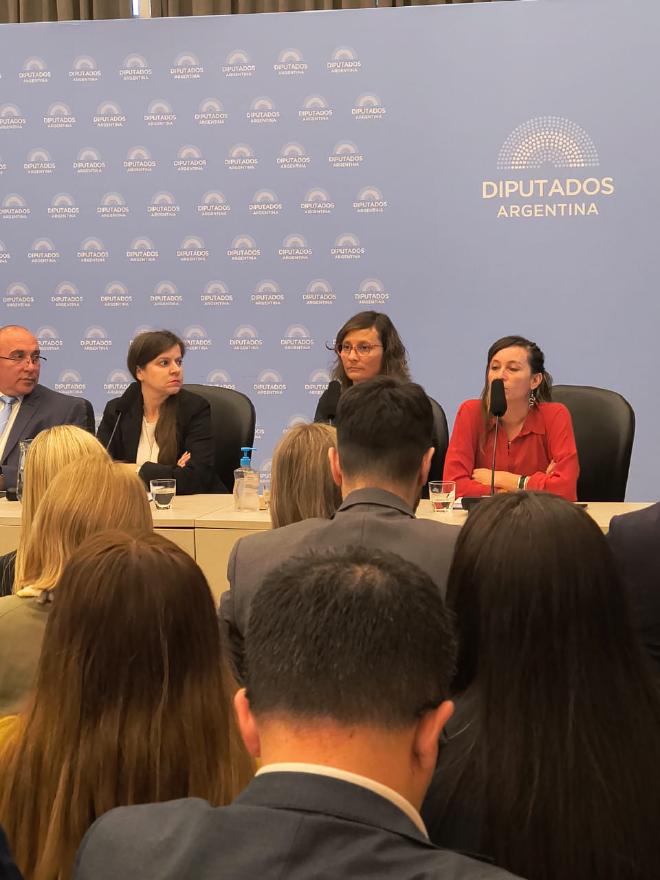
“For La Pampa, water is not an abstract concept, it is a condition of existence,” she said, and remarked that glacial and periglacial environments constitute strategic reserves of fresh water, whose protection is key in a context of climate change and declining flows.
The impact on the Colorado River #
In her presentation, Basso explained that 70% of the population of La Pampa depends on water that comes from the Colorado River, the only active river within the provincial territory. This watercourse is formed by the confluence of the Grande and Barrancas rivers, whose headwaters are located in glacial and periglacial environments of the Andes mountain range, in the province of Mendoza.
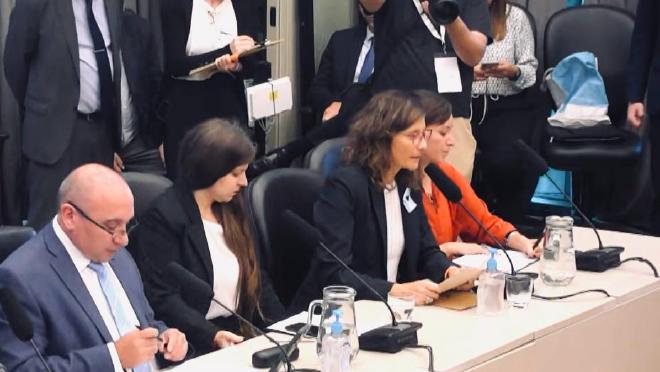
She stressed the importance of maintaining common environmental rules at the national level, warning that rivers cross different jurisdictions and that decisions made at the headwaters inevitably impact the downstream provinces.
La Pampa’s experience with the Atuel River #
Basso also recalled the historical experience linked to the Atuel River, pointing out that La Pampa maintains a ‘painful water memory’ as a result of unilateral decisions adopted upstream.
Legal and environmental arguments #
Basso also raised questions from a legal point of view. She stated that the proposed modification would imply a setback in environmental protection standards, which would violate the principle of non-regression recognized by modern environmental law.
She warned that the initiative contradicts what is established in the National Constitution, which guarantees the right of all inhabitants to a healthy environment and obliges to preserve it for present and future generations.
La Pampa’s position #
Basso ratified the position of the Government of La Pampa regarding the project under debate. “From La Pampa we maintain with absolute firmness that it is not constitutional, ethical or responsible to make the protection of our glaciers more flexible,’ she said, adding that weakening that regulation would imply a setback in terms of environmental federalism.
Contact [Notaspampeanas](mailto: notaspampeanas@gmail.com)