


Van Deelen cited a study published in Nature Climate Change as the first to incorporate glacial isostatic adjustment—how land beneath heavy ice sheets uplifts after the ice retreats—into projections of ice-free land emergence in Antarctica. The results reveal that climate change could expose potentially valuable mineral resources that may spur renegotiations of the international treaties that currently govern Antarctica.
Invaluable resources will emerge #
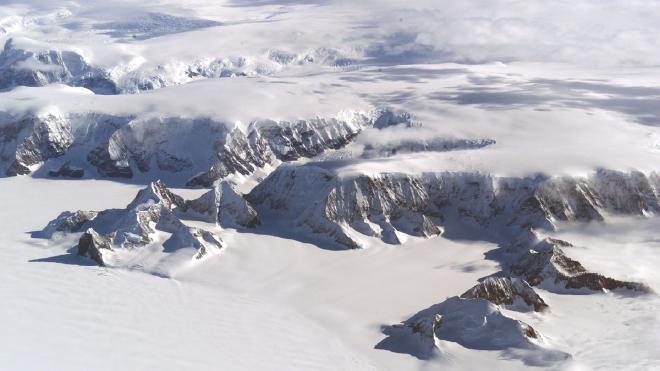
Beneath Antarctica’s ice sheet lies a varied landscape with mountains, canyons, valleys, and even volcanoes. As the climate warms, the ice sheet is slowly retreating, uncovering some of that land.
But until now -wrote van Deelen-, projections of ice-free land emergence had considered only changes to ice margins—how the spatial extent of ice cover will shift. Simulations of Antarctica’s future accessible land hadn’t considered how land would uplift once uncovered by ice or how different sea level scenarios would affect the amount of ice-free land that might emerge.
The study estimated that 120,610 square kilometers (46,578 square miles), 36,381 square kilometers (14,047 square miles), and 149 square kilometers (58 square miles) of land would emerge by 2300 under high–, medium–, and low–ice melt conditions, respectively. “We know we’ve had ice retreat and grounding line retreat over the past couple of decades,” so the ranges of projected ice-free land emergence were not surprising, Lucas said.
Yes, in the South Pole you’ll find politics #
Currently, commercial mineral extraction is not allowed in Antarctica, though the Antarctic Treaty does allow for activities related to mineral resources if they are conducted strictly for scientific purposes.
The study authors suggested that these changes to Antarctic land could put pressure on the region’s legal framework surrounding mineral resource activities. “That’s a fair assessment,” wrote Tim Stephens, a professor of international law at the University of Sydney Law School who was not involved in the new study, in an email. “However, the ice-free land emergence projected by the new study is unlikely to trigger a major change to Antarctic governance on its own,” he wrote.
Really? #
“The continent will still remain a very challenging environment for mineral resource extraction,” he wrote, adding that the transformation of the Antarctic environment could also spur greater cooperation and focus on the environmental protection objectives of the Antarctic Treaty.
—Grace van Deelen (@gvd.bsky.social), Staff Writer
Citation: van Deelen, G. (2026), As ice recedes and land rebounds, Antarctica’s mineral resources come into focus, Eos, 107, https://doi.org/10.1029/2026EO260103. Published on 30 March 2026.
Text © 2026. AGU. CC BY-NC-ND 3.0
Except where otherwise noted, images are subject to copyright. Any reuse without express permission from the copyright owner is prohibited.
Citation #
- The study Emergence of Antarctic mineral resources in a warming world was published in Nature Climate Change journal. Authors: Erica M. Lucas, Fred D. Richards, Gabriel Cederberg, Xiyuan Bao, Mark J. Hoggard, Stephen R. J. Tsuji, Konstantin Latychev, Leonard J. S. Tsuji & Jerry X. Mitrovica
Lucas, E.M., Richards, F.D., Cederberg, G. et al. Emergence of Antarctic mineral resources in a warming world. Nat. Clim. Chang. (2026). https://doi.org/10.1038/s41558-026-02569-1
Received 23 June 2025
Accepted 16 January 2026
Published 20 February 2026
Version of record 20 February 2026
DOI https://doi.org/10.1038/s41558-026-02569-1
- The article As Ice Recedes and Land Rebounds, Antarctica’s Mineral Resources Come into Focus, signed by Grace van Deelen was published today on **Eos.org**
Contact [Notaspampeanas](mailto: notaspampeanas@gmail.com)