


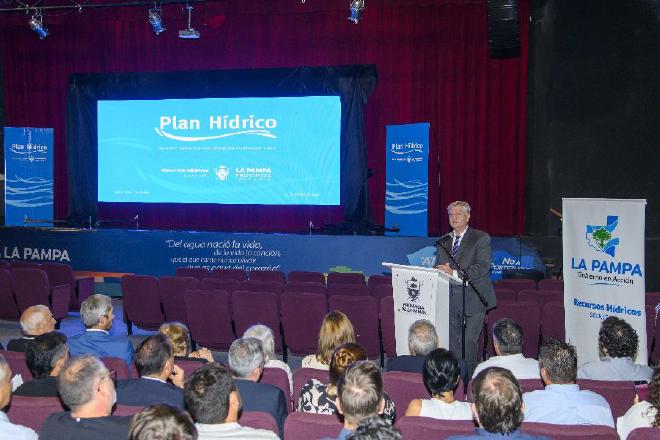
The initiative is part of a public policy that considers water as a strategic resource and an essential human right, especially in the context of growing demand and climate variability.
Key Points of the Water Plan: #
Strategic Vision #
The plan seeks to guarantee water security in La Pampa, understood as sustainable access to sufficient and quality water for domestic, productive and environmental uses.
Comprehensive Diagnosis: #
It is based on an exhaustive analysis that identifies water as a limited and unevenly distributed resource in the province. Dependence on groundwater sources is highlighted and a possible 40% increase in water demand is projected in the next ten years, exacerbated by climate change, which is considered a ‘water crisis’.
Main lines of action: #
The strategy is articulated in four main axes:
-
Governance and Water Security: Includes the legal and administrative regulation of water use, the regulation of drilling and concessions, the protection of aquifers and the creation of instruments such as a Provincial Water Fund.
-
Hydrometeorological Monitoring: Proposes the creation of a Pampean Hydro-Meteorological Observatory, the systematization of data and the development of early warning systems for floods and droughts.
-
Awareness and Education: Seeks to promote responsible use campaigns, educational programs and actions to promote citizens committed to the care of water resources.
-
Recovery of Interjurisdictional Rivers: Reaffirms the historical claim of La Pampa for the Atuel and Salado-Chadileuvú-Curacó rivers, through political, judicial and social actions.
Defense of the Glacier Law: The Pampas governor expressed strong concern about the possible modification of the Glacier Law, warning that this represents a direct threat to the availability of water and water sovereignty. He compared it with past negative experiences for the province, such as the case of ‘Portezuelo del Viento’, and described the modification as ’the delivery of a strategic resource’ and ’the delivery of a national identity in the defense of a strategic resource such as water’. He called on national legislators to act responsibly in the face of this situation.
Articulation with Municipalities: A joint work strategy was announced with municipalities and mayors to optimize the use of water throughout the provincial territory. Framework agreements will be proposed and a specific fund of 500 million pesos will be created to strengthen local water management.
Communication and Education: The communication strategy ‘Water in La Pampa’ was launched, which includes an educational documentary with the aim of consolidating a critical citizenship in the use of water, economically valuing the resource, strengthening institutional management and legally protecting water resources.
Expected Results: Among the objectives of the plan are the consolidation of critical citizenship, the economic valorization of the resource, institutional strengthening, legal protection of water resources, continuity in the defense of interprovincial rivers and the generation of a comprehensive database for decision making.
Contact [Notaspampeanas](mailto: notaspampeanas@gmail.com)