


  1. Posts/

Saving water, generating energy and making tomato cultivation more sustainable at the same time

·3 mins·
Notaspampeanas
Agriculture Engineering Energy Resources Food Science Growing Tomatoes Agrovoltaic Systems Deficit Irrigation Tomato Cultivation Regulated Deficit Irrigation Land Equivalent Ratio
Notaspampeanas
Author
Notaspampeanas
Digging on curiosity and science.
Table of Contents

Researchers from the University of Seville (US) and the Polytechnic University of Madrid (UPM) have demonstrated that it is possible to grow tomatoes and generate solar energy simultaneously, a key strategy for tackling global water scarcity. The study, carried out in Madrid and Seville during the spring of 2024, evaluated the use of agrovoltaic systems and regulated deficit irrigation to optimise water resources in tomato cultivation. The results show that, although using less water reduces the volume of the harvest, the overall outcome is a more efficient and sustainable process.

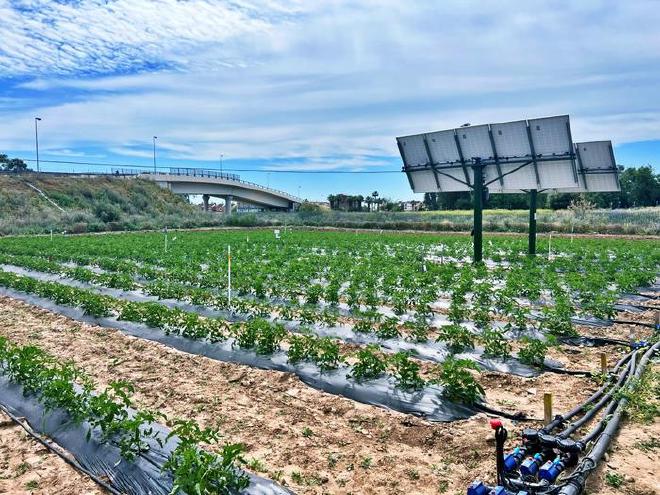
Sustainable production of horticultural crops based on agrivoltaic systems. Image credit: University of Seville

This innovative combination aims to reduce the plants’ evaporative demand through the shade provided by photovoltaic panels, enabling a more efficient use of land and water. The research compared three irrigation methods: a control group with full irrigation, a regulated deficit irrigation (RDI) system based on the plant’s water status, and an agrovoltaic (AG) system that applied the same water restriction under solar panels. The study measured variables such as leaf water potential and gas exchange to monitor plant stress at different growth stages. The results indicate that, although the shade from the panels reduces available radiation, the design of the system permits adequate plant development to be maintained at most stages of the crop cycle.

One of the most notable findings is that the deficit irrigation strategy reduced water consumption by approximately 50% compared to traditional irrigation. However, this drastic reduction in water led to a yield decrease of around 20% in the RDI treatment, attributed mainly to severe water stress conditions during the ripening phase. Despite this drop in total tomato production, irrigation water productivity increased significantly in the Seville treatments, demonstrating that more fruit can be obtained for every drop of water invested.

Furthermore, the overall success of the agrovoltaic system was validated by the Land Equivalent Ratio (LER), which combines the efficiency of agricultural and electricity production. The values obtained—1.54 in Madrid and 1.67 in Seville—confirm that combined production is far more efficient than growing tomatoes and generating energy on separate plots. This implies that, although tomato yield decreases under the panels, the system’s profitability and sustainability increase thanks to the generation of clean energy in the same space.

In conclusion, the study highlights that agrovoltaics is a promising tool for the agriculture of the future, although it requires more precise irrigation management to avoid excessive stress. The researchers suggest that combining plant measurements with soil moisture sensors could further optimise these systems. This advance points to the sustainable dual use of land, offering a viable solution to the challenges of climate change and the energy transition.

The study forms part of the Ministry of Science and Innovation and the State Research Agency’s PID2021-122772OB-I00 project, entitled ‘Sustainable vegetable production based on agrovoltaic systems’. It was led by experts from the ETSIAAB at the Polytechnic University of Madrid, CEIGRAM and the ETSIA at the University of Seville. The results are published in the prestigious scientific journal Agricultural Water Management.

Citation
#

  • The study Regulated deficit irrigation based on plant water status and Agrivoltaic systems as possible improvements on water resources management in tomato was published in Agricultural Water Management. Authors: Carlota Bernal-Basurco, Marta Sánchez-Piñero, Ana Centeno, María José Martín-Palomo, Esther Hernández-Montes, Pedro Castro-Valdecantos, Ruben Moratiel, Jesús D. Peco, Alfonso Moriana, David Pérez-López, Mireia Corell.

Contact [Notaspampeanas](mailto: notaspampeanas@gmail.com)


Related

La Pampa: Observatory of productive experiences organized to face soil salinization
·2 mins
Notaspampeanas
La Pampa Agriculture Soils Salinity Agricultural Management Productivity Profitability
Argentina: Tick-borne bacteria detected in wildlife
·4 mins
Notaspampeanas
Argentina INTA Zoonosis Ehrlichia Chaffeensis Ciervo De Los Pantanos Fauna Silvestre
When oxygen determines if a limb can regrow
·5 mins
Notaspampeanas
Tissue Regeneration Vertebrate Limb Regenerate Oxygen-Sensing Amphibians
Study from UBC its pointing that summer is getting longer, and it’s happening faster than we thought
·4 mins
Notaspampeanas
Global Warming Climate Change Expanding Summers Cumulative Summer University of British Columbia Geography Earth, Ocean, and Atmospheric Sciences Seasons Rhythm Resources Environment Sustainability Ted J. Scott Rachel H. White Simon D. Donner Environmental Research Letters
As Ice Draw Back and Land Reappears, Antarctica’s Mineral Resources Come into Focus
·5 mins
Notaspampeanas
Antarctica Climate Change Global Warming Climate Change Impacts Climate Change Policy Cryospheric Science Mining Antarctic Treaty
The Conversation AI
·3 mins
Notaspampeanas
Artificial Intelligence The Conversation Global La Conversación Ramesh Srinivasan University of California Los Angeles