


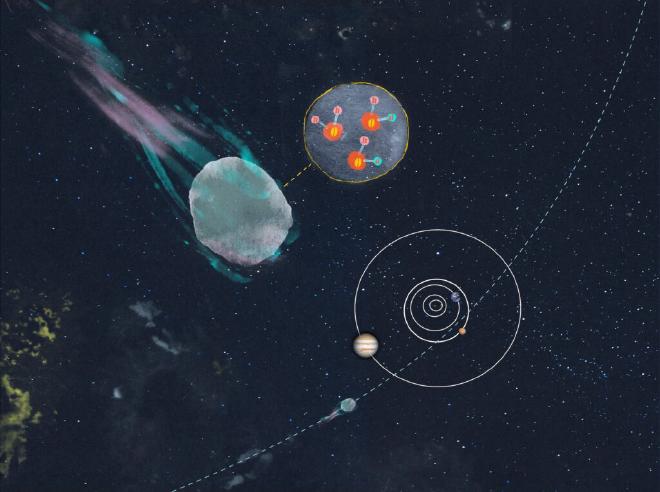
Aunque aún se desconoce de dónde procede este objeto interestelar llamado 3I/ATLAS, una investigación dirigida por la Universidad de Michigan reveló nuevos datos sobre su lugar de nacimiento. Dondequiera que estuviera, es mucho más frío que el ambiente que creó nuestro sistema solar.
“Nuestras nuevas observaciones muestran que las condiciones que llevaron a la formación de nuestro sistema solar son muy diferentes de cómo evolucionaron los sistemas planetarios en diferentes partes de nuestra galaxia”, dijo Luis Salazar Manzano, autor principal del nuevo estudio y estudiante de doctorado en el Departamento de Astronomía de la Universidad de Michigan.
La composición de ‘dos aguas diferentes’ #
Estas formas más pesadas de agua también existen en la Tierra, pero en cantidades mucho menores que las observadas en 3I/ATLAS.
“La cantidad de deuterio con respecto al hidrógeno ordinario en el agua es mayor que cualquier cosa que hayamos visto antes en otros sistemas planetarios y cometas planetarios”, dijo Salazar Manzano. De hecho, la proporción era 30 veces mayor que la de cualquier cometa de nuestro sistema solar, dijo Salazar Manzano, y 40 veces el valor encontrado en el agua de nuestros océanos.
Para realizar un estudio sin precedentes como éste fue necesario que muchas cosas salieran bien, afirmaron desde el equipo. Todo comenzó cuando los astrónomos descubrieron 3I/ATLAS lo suficientemente temprano como para permitir estudios de seguimiento, según Paneque-Carreño.
Fue entonces cuando Salazar Manzano se puso en contacto con Paneque-Carreño para trabajar en conjunto, quien aportó su experiencia con el Atacama Large Millimeter/submillimeter Array, o ALMA, en Chile para observar y caracterizar más a fondo las propiedades químicas del cometa.
ALMA es lo suficientemente sensible como para detectar la sutil diferencia entre el agua deuterada y la convencional, por lo que el equipo pudo caracterizar la proporción entre las dos. Este estudio representa la primera vez que los científicos han podido realizar este tipo de análisis en un objeto interestelar.
“Estar en la Universidad de Michigan y tener acceso a estas instalaciones fue la clave para hacer posible este trabajo”, afirmó Salazar Manzano. “Éramos parte de un equipo muy talentoso y con mucha experiencia en múltiples áreas, todos nos complementábamos y eso es lo que nos permitió analizar e interpretar estos conjuntos de datos”.
“Necesitamos cuidar nuestros cielos nocturnos y mantenerlos claros y oscuros para que podamos detectar estos objetos diminutos y difusos”, dijo.
Cita #
- El estudio Water D/H in 3I/ATLAS as a probe of formation conditions in another planetary system (Agua D/H en 3I/ATLAS como sonda de las condiciones de formación en otro sistema planetario) fue publicado en Nature Astronomy. Autores: Luis E. Salazar Manzano, Teresa Paneque-Carreño, Martin A. Cordiner, Edwin A. Bergin, Hsing Wen Lin (林省文), Dariusz C. Lis, David W. Gerdes, Jennifer B. Bergner, Nicolas Biver, Dominique Bockelée-Morvan, Dennis Bodewits, Steven B. Charnley, Jacques Crovisier, Davide Farnocchia, Viviana V. Guzmán, Stefanie N. Milam, John W. Noonan, Anthony J. Remijan, Nathan X. Roth & John J. Tobin
Financiación #
La financiación adicional para este trabajo provino de la Sociedad de Becarios de Michigan y la Fundación Heising-Simons. ALMA es una asociación entre el Observatorio Europeo Austral, la NSF y los Institutos Nacionales de Ciencias Naturales de Japón en cooperación con la República de Chile.
Contacto [Notaspampeanas](mailto: notaspampeanas@gmail.com)