Probiotic yeasts from CONICET researchers show improvements in the fattening and intestinal health of pigs.
·5 mins·
Notaspampeanas
Author
Notaspampeanas
Digging on curiosity and science.
Table of Contents
Table of Contents
This is a yeast jointly developed by different research groups of the Council, obtained from a residue of the dairy industry. Last year, the know-how associated with its fermentation and formulation process was transferred to a biotechnology company.
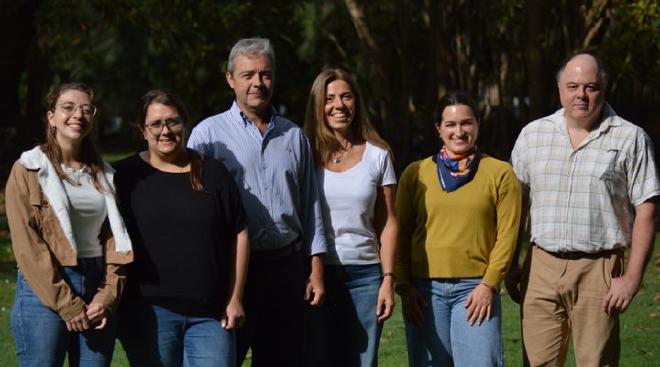
The research team: (from left to right) Eugenia Tanco, Malena Ferreyra Compagnucci, Martín Rumbo, Graciela Garrote, María Dolores Pendón and Sebastián Cavalitto. Photo: CONICET Photography/Rayelen Baridon.
Less than a year after the signing of a technology license agreement between CONICET and the National University of La Plata (UNLP) with the company Beneficial Germs S.A. for the transfer of knowledge regarding the development of a probiotic yeast, its large-scale production, and its potential applications in animal and human health, scientific advances continue to mark the path. The latest news is the publication of a scientific article in the journal Probiotics and Antimicrobial Proteins, in which they prove that piglets that receive a supplement of the probiotic yeast gain 10 percent more weight than those that only eat their usual food.
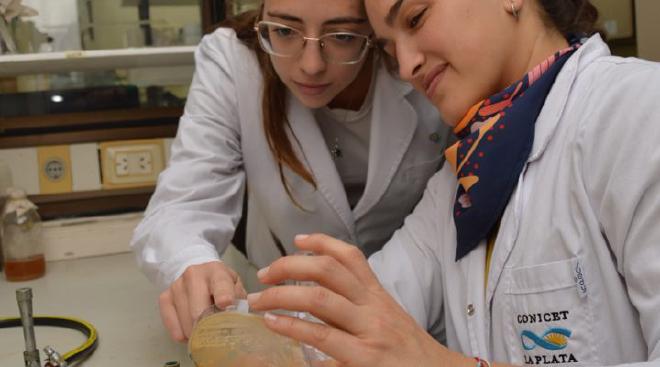
Eugenia Tanco and María Dolores Pendón in the laboratory. photo: CONICET Photography/Rayelen Baridon.
The yeast, named Kluyveromyces marxianus CIDCA 9121, has properties that contribute to gastrointestinal health. It is produced from whey, a dairy industry byproduct, which adds sustainability to the project. Developed jointly by the Center for Research and Development in Food Science and Technology (CIDCA, CONICET-UNLP-CICPBA), the Institute of Immunological and Pathophysiological Studies (IIFP, CONICET-UNLP-associated with CICPBA), and the Center for Research and Development in Industrial Fermentations (CINDEFI, CONICET-UNLP), the agreement signed at the time transferred the know-how – that is, how it is done – associated with the fermentation and formulation process to the biotechnology company.
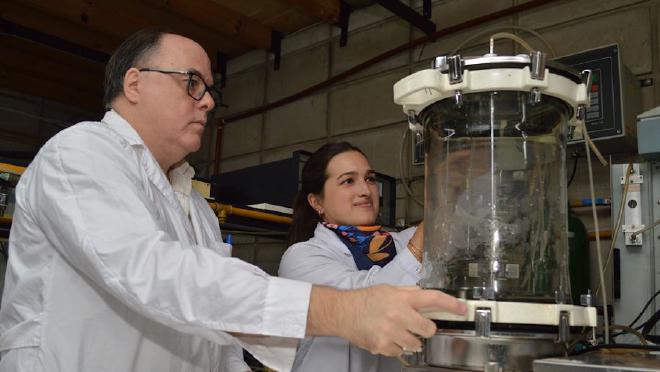
Sebastián Cavalitto and María Dolores Pendón conduct tests at CINDEFI. Photo: CONICET Photography/Rayelen Baridon.
In the new study, which also involved research professors from the Faculty of Veterinary Sciences (FCV, UNLP), the probiotic was incorporated into the diet of pregnant sows during the three weeks prior to farrowing and lactation, while others received only balanced feed. In turn, the piglets from each group were also fed in the same way during the first weeks after weaning: some with the yeast and others without it. The result? Conclusive: forty days later, the supplemented group showed a 10 percent increase in weight compared to the other.
“In pig production, weaning or the separation of piglets from the mother occurs at very early ages, when the intestine is not fully mature for the incorporation of solid food, and this predisposes them to infections. The usual practice, then, is to resort to antibiotics,” explained Martín Rumbo,CONICET researcher and director of IIFP, who emphasized: “Yeast has shown that it can be an alternative to the use of preventive medications, at least in the first months of life,” something essential in the fight against antibiotic resistance.
In addition to the results obtained, this work is a great leap forward scientifically: from trials with models in mice, they moved on to testing with animals from a productive farm in the town of Ranchos, in what was “a real-life experience, carried out in a much less controlled environment, with a number of variables that exceed laboratory conditions,” described Malena Ferreyra Compagnucci, a fellow at IIFP and also an author of the work. “It is a direct application that closely approximates the functioning we expect the product to have once developed,” pointed out Rumbo.
“It is scientific evidence that remains available at the academic level, and which is also necessary to have for the formulation, registration, and commercialization of eventual products. All the data that is obtained from the different trials will serve to know what dose of yeast is needed for a supplement intended for pregnant or lactating sows, or only for piglets, or at what stage of the offspring’s development it is advisable to administer it, among other issues,” stated Graciela Garrote and María Dolores Pendón, CONICET researcher and scholarship holder, respectively, at CIDCA.
Having proved the efficacy and biological functionality of yeast as a probiotic supplement, and while further tests are being conducted to continue refining the available information, another search is proceeding in parallel: that of optimizing its own development. From CINDEFI, its director Sebastián Cavalitto explained that “microbiological derivatives can be sold as a liquid product, that is, in a suspension; as a paste or fresh, containing a certain amount of moisture; or dry, as a powder, a format that has much greater durability.”
Of the three presentations, work is being done on drying, a process for which an advanced dehydration technique called freeze-drying is used in research, but which in this case has the disadvantage of cost: it is excessively expensive for a commercial product.“What we are currently testing is spray drying, used for example to make powdered milk, a method that is more scalable at the production level,”Cavalitto said. For the coming months, the research teams involved expect to publish new results on the different fronts addressed to continue expanding the possibilities of this valuable development.
The study Kluyveromyces marxianus CIDCA 9121 as Probiotic Supplement for Sows and Piglets: Effects on Biological and Productive Outcomes During Early Post-weaning, was published on Probiotics & Antimicro. Prot. (2026). Authors: Pendón, M.D., Ferreyra Compagnucci, M., Valette, E. et al.
The article Levaduras probióticas del CONICET muestran mejoras en el engorde y la salud intestinal del ganado porcino signed by Mercedes Benialgowas published on CONICET’s news section