

  1. Posts/

CONICET scientists find a new 70-million-year-old reptile in Argentine Patagonia

·6 mins·
Notaspampeanas
CONICET Paleoteius Lakui MACN Federico Agnolin Martín Ezcurra Paleoteius Late Cretaceous Argentine Patagonia National Geographic Society Paleontology Laboratory of Comparative Anatomy and Vertebrate Evolution Argentine Museum of Natural Sciences Río Negro Scientific Reports Allen Formation Yacimiento De Salitral Ojo De Agua Fundación Félix De Azara Gondwana Pangaea Scincomorpha High-Performance Computing Center National University of Cordoba
Notaspampeanas
Author
Notaspampeanas
Digging on curiosity and science.
Table of Contents

It is the most complete terrestrial lizard known to date for the Late Cretaceous in South America; its discovery provides clues to understanding how these animals evolved before the mass extinction at the end of that period. The discovery was made as part of a project supported by the National Geographic Society.

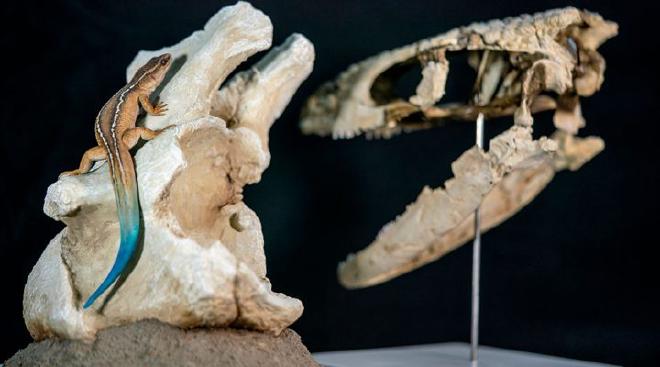
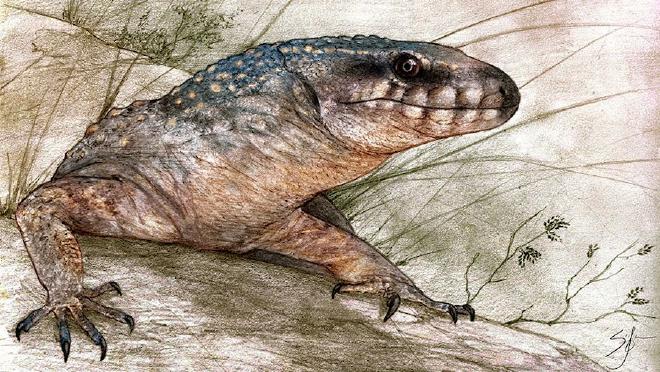
Reconstruction of Paleoteius. Credits Sebastián Rozadilla.

An international paleontological team, led by scientists from CONICET at the Laboratory of Comparative Anatomy and Vertebrate Evolution (LACEV) of the Argentine Museum of Natural Sciences (MACN, CONICET), found fossil remains in the province of Río Negro of a reptile that lived about 70 million years ago. It is the most complete terrestrial lizard known for the late Cretaceous period, a period whose end, 65 million years ago, was marked by the extinction of three-quarters of the plant and animal species that inhabited Earth, including all dinosaurs (with the exception of birds). The discovery, published in the journal Scientific Reports, provides key evidence for understanding the evolution of reptiles on the southern hemisphere continents in the period prior to that event.

The new species, named Paleoteius lakui, was discovered in rocks of the Allen Formation, at the Salitral Ojo de Agua site, a region near the one that in October 2025 gave rise to the joint streaming between CONICET and the “Félix de Azara” Foundation, where a carnivorous dinosaur egg was found.

Reconstruction in life of the Paleoteius, by the artist Lautaro Rodríguez Blanco.

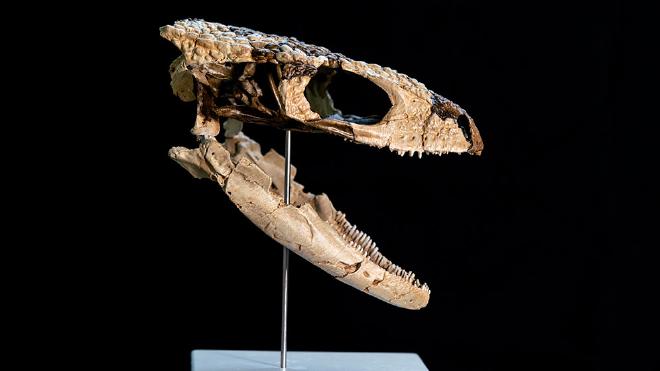
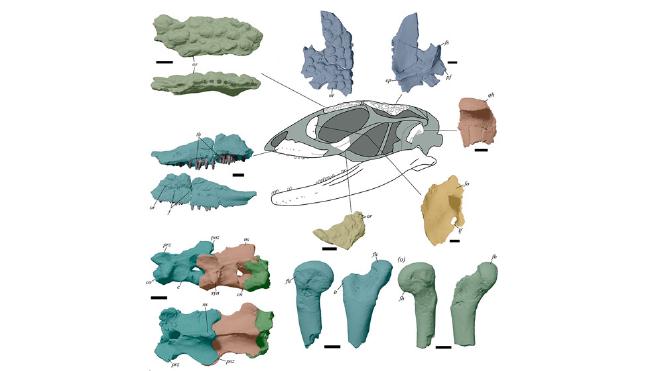
According to the scientists’ description, Paleoteius was a small reptile just over 15 centimeters long, with a skull heavily ornamented by small bumps and jaws armed with numerous fine, simple, and uniform teeth, which possibly served it to catch insects.

Reconstruction of the skull of Paleoteius by technician Santiago Miner

“Fossil remains of small animals are generally very scarce. Particularly lizards and geckos, due to their small size and great fragility, fossilize very little. The remains found are, in general, very incomplete. In this case, we were lucky to find a large part of the skeleton, with much of the skull, which for the first time provides a lot of information about the history of these reptiles in the southern cone. If one considers that, for Patagonia, directly, almost no remains of this type are known, it must be said that the discovery of Paleoteius fills a gap of tens of millions of years,” pointed out Federico Agnolín, first author of the study and CONICET researcher at LACEV-MACN.

An interdisciplinary study
#

The study of the fossil was possible thanks to the use of advanced technologies that allowed it to be analyzed without damaging the remains. In this regard, specialists highlight that the use of computed microtomography made it possible to digitally reconstruct the internal anatomy of the specimen with micrometer resolution. These studies were carried out in collaboration with scientists from the National Atomic Energy Commission (CNEA). With this data, they were able to create three-dimensional models that facilitated anatomical and comparative analysis.

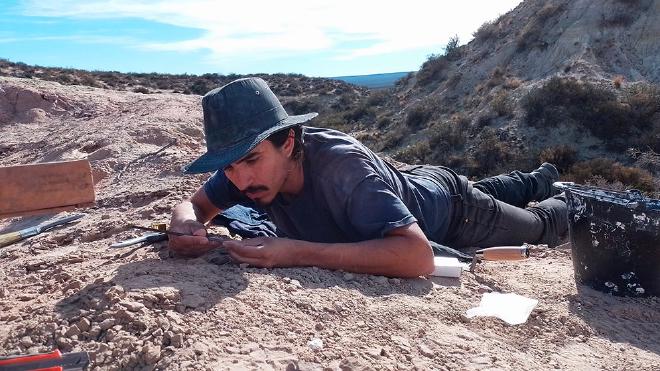
Gerardo Álvarez Herrera looking for fossils in the excavation of Paleoteius. Photo: courtesy of researchers.

The study of the fossil was possible thanks to the use of advanced technologies that allowed it to be analyzed without damaging the remains. In this regard, specialists highlight that the use of computed microtomography made it possible to digitally reconstruct the internal anatomy of the specimen with micrometer resolution. These studies were carried out in collaboration with scientists from the National Atomic Energy Commission (CNEA). With this data, they were able to create three-dimensional models that facilitated anatomical and comparative analysis.

“It is important to highlight that it was an interdisciplinary work, in which we collaborated with colleagues from other areas of science to be able to analyze such complex remains as those of a very small lizard, whose skull measures barely 2 centimeters in length. To study teeth that measure less than a millimeter or the way these teeth are implanted, as well as other detailed characteristics of the animal’s skeleton, requires technological analyses that we cannot carry out in our paleontology laboratories. If it weren’t for the technology provided by CNEA and the contribution of its scientists, we would not have been able to study the anatomy of Paleoteius in detail as we did,” pointed out Mauro Aranciaga Rolando, also an author of the research.

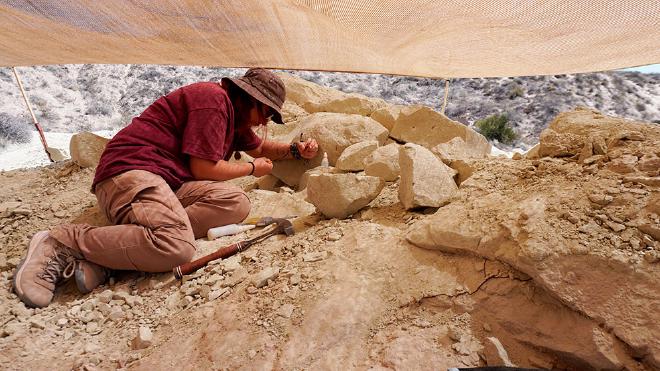
The technician Ana Moreno Rodríguez looking for fossils in the excavation of Paleoteius. Photo: courtesy of researchers.

Furthermore, phylogenetic analyses, key to understanding the genealogical relationships of the new species, required the use of high-performance computing resources provided by the High-Performance Computing Center (CCAD) of the National University of Córdoba (UNC), part of the national SNCAD-SICYT system.

Phylogenetic classification
#

Agnolín highlighted that the finding becomes particularly important if one takes into account that the fossil record of lizards from the Mesozoic (an era encompassing the Triassic, Jurassic, and Cretaceous periods) in the Southern Hemisphere is less than a dozen species, while more than 150 species are known for the Northern Hemisphere.

Remains of skull and part of the skeleton of Paleoteius.

In that context, Paleoteius not only expands the lizard record for the southern continents, but also reveals the existence of lineages previously unknown in South America as they do not belong to any known group. On the other hand, the analyses indicate that the closest relatives of this lizard would be widely distributed on other continents, which would show that lizards were already diversified in Gondwana – the southern continental block that formed part of the supercontinent Pangaea.**

According to the specialists’ analysis, the structure of the jaw and skull allow it to be placed within the Scincomorpha, a large group of lizards that currently includes very diverse forms—such as skinks, girdled lizards, and night lizards—distributed almost worldwide, but which until now lacked fossil remains in South America.

“The discovery of Paleoteius allows us to fill one of the most important gaps in the fossil record of reptiles and opens the way for us to improve our understanding of how the group evolved before the mass extinction that marked the end of the age of dinosaurs,” assured Martín Ezcurra, a CONICET researcher at MACN and also an author of the research.

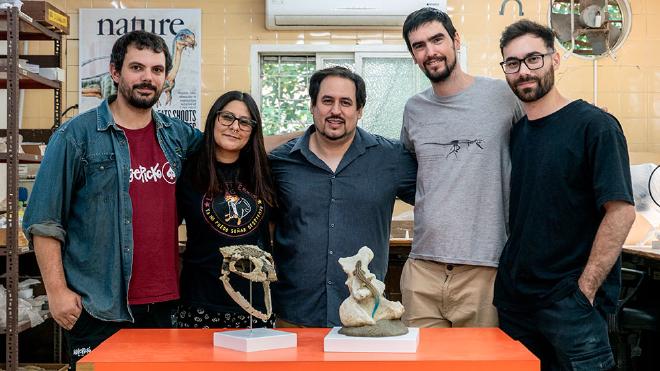
Part of the team that starred in the discovery and description of the fossil. Photo: courtesy of researchers.

In addition to the LACEV team, scientists from the Félix de Azara Natural History Foundation, the Patagonian Museum of Natural Sciences, the National Atomic Energy Commission, and a colleague from the University of Frankfurt (Germany) also participated in the discovery and description of the fossil.

The project was supported by the National Geographic Society, within the framework of research for the “End of the Dinosaur Era in Patagonia” project, which encompasses multiple museums and research centers, as well as more than 80 researchers.

Citation
#

  • The study A new late Cretaceous squamate from Patagonia sheds light on Gondwanan diversity. was published on Scientific Reports. Authors: Agnolín, F. L., Aranciaga-Rolando, M., Álvarez-Herrera, G., Ezcurra, M. D., Rodríguez, A. M., Chafrat, P., … & Novas, F. E. (2026)**

  • The article Científicos del CONICET hallan en la Patagonia argentina un nuevo reptil de 70 millones de años, signed by Miguel Faigón was published on the CONICET’s new section


Contact [Notaspampeanas](mailto: notaspampeanas@gmail.com)


Related

FIL researchers discover an energetic “strategy” of the brucellosis bacteria to optimize its multiplication
·5 mins
Notaspampeanas
FIL CONICET Molecular and Cellular Microbiology Laboratory Microbiology Brucella Scientific Reports Mur Fur4
CONICET team develops a device for domestic use to remove micro and nanoplastics from water
·4 mins
Notaspampeanas
Microplastics Nanoplastics INTEMA CONICET UNMdP Science of Materials Technology of Materials 2025 Franco-Argentine Innovation Award Carla Di Luca Materials Development
CONICET scientists are making progress in developing a digital diagnostic device for hepatitis E
·6 mins
Notaspampeanas
Hepatitis E CONICET ViroSensAr Network Gisens Biotech INIFTA INQUIMAE INSIBIO MIT Artificial Intelligence Bioelectronics Nanotechnology
AGGRESCANAI, a software developed to study proteins associated with Alzheimer's, Parkinson's and other neurodegenerative diseases
·3 mins
Notaspampeanas
AggrescanAI Leloir Institute Foundation CONICET Alzheimer Parkinson ELA Neurodegenerative Diseases ITBA Art
CONICET hosted a Regional Networking meeting for the preparation of projects on Antimicrobial Resistance
·2 mins
Notaspampeanas
CONICET Regional Networking Meeting Antimicrobial Resistance ANII CONACYT FAPES FAPESP International Cooperation
An Ancient Landscape Beneath the East Antarctic Ice Sheet
·2 mins
Notaspampeanas
Anthropogenic Climate Change Antarctic Geophysics Coats Land East Antarctic Ice Sheet Paxman Et Al. Glaciology Weddell Sea Gondwana