


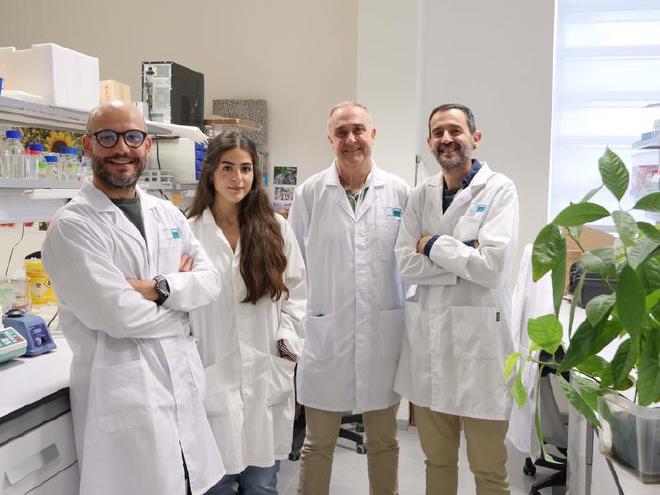
The research team, which also belongs to the Institute of Subtropical and Mediterranean Horticulture ‘La Mayora’ (IHSM), has demonstrated that this sustainable agricultural management system enriches specific groups of soil microorganisms, particularly bacteria, helping plants to stand up to climate change.
Invisible allies of plants #
For the development of this study, two avocado orchards were compared: one managed organically, without chemicals and with organic matter, and the other conventionally, using fertilizers and intensive management, both located in the area of the Axarquía in Malaga.
“By comparing the rhizosphere (the soil attached to plant roots) of crops under organic and conventional management over 20 years, we identified important differences in their physicochemical properties that play a key role in the composition of microbial communities, observing an abundance of bacteria of the genus Bacillus”, explained the researcher and first author of this paper Blanca Ruiz Muñoz.
In a second phase, in the laboratory, the researchers isolated bacteria of the genus Bacillus and evaluated their effect on plants. Through different trials, they observed that some of these microorganisms improved plant physiological state and growth under drought conditions. “Therefore, it is not only that these bacteria are better prepared to survive under stressful conditions such as scarcity of water, but also play a direct role in plant survival,” they said.
Towards a new form of agriculture #
According to these experts, these findings are especially relevant in southern Spain, with very dry areas, where more resilient crops would mean fewer losses; moreover, they would also bring other important benefits such as reduction of the use of fertilizers and chemicals, in favor of ‘bioinoculants’, products formulated with microorganisms that are beneficial to soil.
In short, the way crops are cultivated today could enhance the ability of future crops to withstand climate change, so the key to surviving drought could lie underground.
Together with the UMA-IHSM research team, composed of Blanca Ruiz Muñoz, Víctor Carrión, Francisco Cazorla and José A. Gutiérrez Barranquero, researcher Kevin M. Bretscher, from the Institute of Biology of the University of Leiden, is also part of this publication.
Citation #
- The paper Long-term organic farming shapes the avocado rhizosphere microbiota through the enrichment of drought-tolerant Bacillus spp. was published in npj Biofilms and Microbiomes Authors: Ruiz-Muñoz, B., Bretscher, K.M., Carrión, V.J. Cazorla, F.M., Gutiérrez-Barranquero, J.A.
Ruiz-Muñoz, B., Bretscher, K.M., Carrión, V.J. Cazorla, F.M., Gutiérrez-Barranquero, J.A. Long-term organic farming shapes the avocado rhizosphere microbiota through the enrichment of drought-tolerant Bacillus spp.. npj Biofilms Microbiomes (2026). https://doi.org/10.1038/s41522-026-00957-1
Contact [Notaspampeanas](mailto: notaspampeanas@gmail.com)