


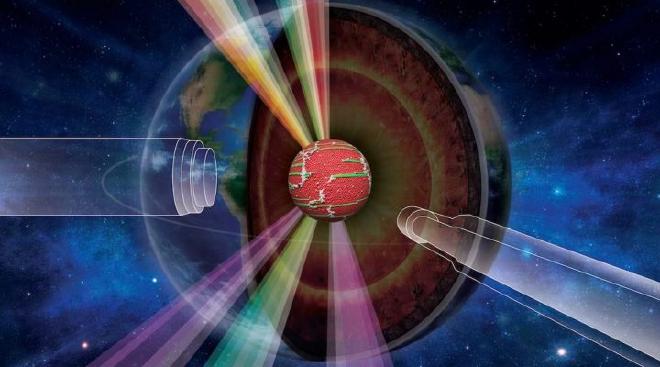
Un equipo internacional de investigación, del que participaron científicos del CONICET, logró medir por primera vez la resistencia dinámica del hierro (Fe) bajo condiciones de presión y temperatura comparables a las del núcleo interno de la Tierra. El estudio, publicado recientemente en la revista Nature Communications, aporta nueva información para comprender la velocidad con la que se transmiten las ondas sísmicas, explicar el origen del campo magnético terrestre y entender cómo evolucionan otros planetas rocosos o asteroides con núcleos similares.
“La resistencia dinámica podría describirse, de manera simplificada, como la “dureza” de un material. La resistencia depende de la velocidad con la que un material se deforma. En la mayoría de los estudios, la deformación se evalúa a velocidades muy bajas, por eso se habla de “dureza” estática o cuasiestática. En cambio, en este estudio, para medir la resistencia del hierro se aplicó una velocidad de deformación muy alta; por eso se habla de resistencia dinámica”, explicó Eduardo Bringa, investigador del CONICET en el Grupo de Simulaciones en Materiales, Astrofísica y Física (SIMAF) de la Facultad de Ingeniería de la Universidad de Mendoza (UM), quien formó parte del equipo que llevó adelante el estudio.
Los experimentos realizados en el NIF permitieron efectuar diagnósticos ultrarrápidos de rayos X y técnicas ópticas para seguir la evolución del material mientras se deformaba. Posteriormente, los datos experimentales fueron interpretados con ayuda de simulaciones hidrodinámicas (a escala microscópica) y de Dinámica Molecular (escala atómica), lo que permitió obtener una imagen más completa de la respuesta del hierro bajo estas condiciones.
Las simulaciones computacionales fueron llevadas a cabo y analizadas, además de por Bringa, por Orlando Deluigi, becario posdoctoral del CONICET en el SIMAF, y Carlos Ruestes, investigador de la Universidad Politécnica de Madrid (España) y miembro del SIMAF hasta 2019. “Los experimentos permiten alcanzar condiciones extraordinarias, pero para entender qué ocurre dentro del material es necesario observar la respuesta a escala atómica. Las simulaciones utilizando la técnica de Dinámica Molecular ayudan a conectar las medidas experimentales con los mecanismos microscópicos de deformación del hierro”, señaló el científico.
El estudio revela que el hierro sometido a altas presiones sufre una reorganización de sus átomos que modifica su microestructura y afecta su comportamiento mecánico final. Esta información permite comprender mejor la dinámica del núcleo interno terrestre, compuesto aproximadamente en un ochenta y cinco por ciento por este material. Los resultados son relevantes ya que aportan nuevos datos para comprender la dinámica interna de la Tierra y de otros planetas similares.
“La ‘dureza’ del centro de la Tierra determina la velocidad de transmisión de las ondas sísmicas a través del planeta, un parámetro necesario para mejorar las estimaciones de localización y magnitud de sismos. Esta dureza también influye en los mecanismos que generan el campo magnético terrestre, ya que modifica el acoplamiento mecánico y químico entre el centro sólido y el líquido que lo rodea. Además, resulta clave para comprender colisiones de asteroides y contribuye al estudio de otros planetas que también pueden tener núcleos de hierro, uno de los materiales más comunes en el universo”, concluyó el científico.
Cita #
-
KIM, YJ., et al. Dynamic strength of iron under pressure-temperature conditions of Earth’s inner core. Nature Communications, 2026, vol. 17. DOI: 10.1038/s41467-026-72210-4
-
El artículo Miden por primera vez el comportamiento del hierro en condiciones similares al núcleo de la Tierra , firmado por Leonardo Fernández del Área de Comunicación CONICET Mendoza fue publicado en el sitio del CONICET
Contacto [Notaspampeanas](mailto: notaspampeanas@gmail.com)