


These findings are from a study published in the journal Nature Communications by researchers from the Luiz de Queiroz School of Agriculture at the University of São Paulo (ESALQ-USP) and the State University of Ponta Grossa (UEPG), as well as Embrapa Agricultura Digital, one of the decentralized units of the Brazilian Agricultural Research Corporation (EMBRAPA).
The good news is that the researchers estimate that “recarbonizing” about one-third of the country’s agricultural land would be sufficient to meet Brazil’s Nationally Determined Contribution (NDC) under the Paris Agreement, which aims to reduce greenhouse gas emissions by 59% to 67% compared to 2005 levels by 2035.
This goal could theoretically be achieved using sustainable techniques, such as crop rotation, no-till farming, and integrated systems like ICLF (Integrated Crop-Livestock-Forest). Another potential solution is the restoration of degraded pastures, which cover 20 million hectares in the Atlantic Forest alone.
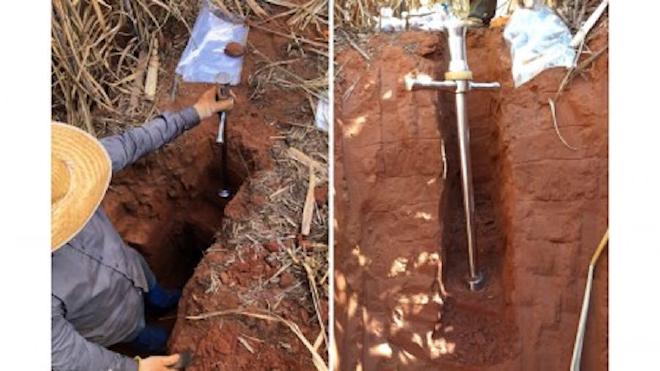
The estimates were derived from an analysis of Brazil’s largest soil carbon database, which the researchers compiled from 4,290 records spanning 372 studies published over the past 30 years. The study covered all Brazilian biomes and included both areas of natural vegetation and agricultural land.
The researchers expect the results of the study to guide public policies and private-sector initiatives to promote sustainable farming practices and inform the carbon credit market with data on Brazilian carbon stocks.
Best practices #
To calculate greenhouse gas emissions, the CO₂ equivalent metric is used to standardize different gases into a single unit of measurement. In this case, the measured amount of carbon is multiplied by 3.66; this explains the difference between 1.4 billion tons of carbon and 5.2 billion tons of CO₂ equivalent. The Atlantic Forest showed the highest soil carbon accumulation in both its natural vegetation and agricultural areas in the study. The Pantanal and the Caatinga (a semi-arid biome in the Northeast region) had the lowest carbon stock levels among the areas measured. The researchers considered the carbon present in the four soil layers typically analyzed in this type of study: 0 to 10 cm, 0 to 20 cm, 0 to 30 cm, and 0 to 100 cm.
In the topsoil layer, carbon stocks in areas of native Atlantic Forest vegetation were 86% higher than in the Caatinga and 36% higher than in the Cerrado (savanna-like biome). In agricultural areas, the Atlantic Forest surpassed the Pantanal and the Caatinga by 154% and 62%, respectively.
The large amount of data allowed the researchers to estimate the types of land conversion that remove the most carbon from the soil in each biome. They also determined how much the transition from monoculture to other agricultural practices can increase the carbon stored in the six biomes analyzed.
In the Amazon, transitioning from monoculture to crop rotation or mixed cropping systems is estimated to generate a potential 14.1% increase in carbon.
In December 2025, Shell, Petrobras, and CCARBON launched Carbon Countdown, *Brazil’s largest carbon stock database. Using a standardized methodology, the project will collect and measure samples across the country to refine the results of the now-published study. If you ae interested you can read more at FAPESP.
The Foundation also supported the work through a **Postdoctoral Fellowship for Júnior Melo Damian at Embrapa Agricultura Digital in Campinas.
Citation #
-
The study Soil carbon debt from land use change in Brazil was published in Nature Communications
-
The article Brazil has lost 1.4 billion tons of soil carbon due to the conversion of natural areas to agriculture, signed by André Julião | Agência FAPESP was published on FAPESP’s website
Contact [Notaspampeanas](mailto: notaspampeanas@gmail.com)