Las plantas caminan por una delgada línea entre crecimiento y defensa
·5 mins·
Notaspampeanas
Ciencias Vegetales
Hormonas Vegetales
Fisiología Vegetal
Ácido Salicílico
Nitzan Shabek
Natalie Hamada
Universidad De California Davis
Autor
Notaspampeanas
Notaspampeanas
Tabla de contenido
Tabla de contenido
El ácido salicílico, la molécula activa de la aspirina y de algunos medicamentos para el acné, es una hormona de las plantas esencial para la inmunidad, pero es un arma de doble filo: demasiado puede causar autoinmunidad y obstaculizar el crecimiento. En un nuevo estudio publicado en Nature Communications, los investigadores de la Universidad de California en Davis descubrieron que las plantas utilizan un sorprendente sistema de múltiples capas para regular los niveles de ácido salicílico y mantener su sistema inmunológico bajo control.
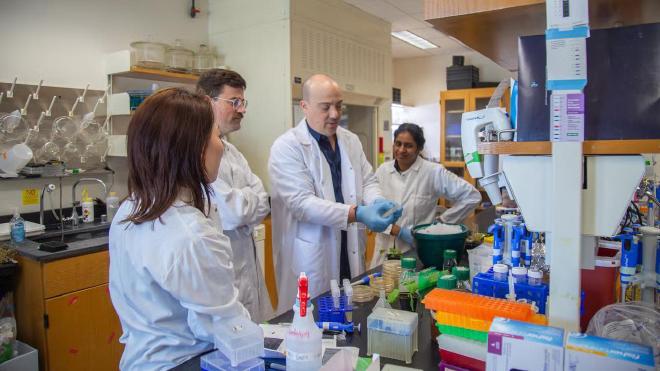
Las plantas utilizan ácido salicílico (la base de la aspirina) como parte de su defensa inmune contra las enfermedades, pero usada en demasía daña el crecimiento de las plantas. Nitzan Shabek y su equipo de UC Davis han descubierto cómo las plantas regulan la cantidad de ácido salicílico en circulación. El trabajo podría conducir a mejoras en la productividad de los cultivos. De izquierda a derecha: los académicos postdoctorales Sunhyun Chang y Jacob Moe-Lange, Shabek y el académico postdoctoral Malathy Palayam. (Crédito de la imagen: Katrina Huynh, Facultad de Ciencias Biológicas de la UC Davis)
El aumento de los niveles de ácido salicílico desencadena la producción de enzimas que descomponen la hormona, pero al realizar su trabajo, las enzimas son marcadas para su eliminación, lo que limita la cantidad de ácido salicílico que pueden destruir. Los hallazgos podrían utilizarse en la agricultura para hacer que los cultivos sean más resilientes a los cambios en su entorno.
“A través de este control en capas, las plantas pueden equilibrar la inmunidad con el crecimiento, respondiendo rápidamente a las amenazas y evitando al mismo tiempo el costo de una defensa prolongada", dijo el autor principal Nitzan Shabek, profesor asociado de biología vegetal en UC Davis, cuyo laboratorio combina bioquímica y biología estructural para investigar la señalización de las plantas. “Nuestro descubrimiento podría abrir la puerta a la innovación en la agricultura al permitir nuevas formas de ajustar la inmunidad de los cultivos sin comprometer el crecimiento”, dijo Shabek.
La primera pista llegó hace unos años, cuando el grupo de investigación de Shabek estaba mapeando proteínas que interactúan con el sistema de ubicuitina, la maquinaria que utilizan las células para reciclar proteínas. En ese estudio, publicado en New Phytologist, el equipo se sorprendió al detectar dos enzimas destructoras del ácido salicílico (DMR6 y DLO1) como posibles objetivos de ubicuitina.
“Me intrigó la posibilidad de que las mismas enzimas responsables de desactivar el ácido salicílico estén siendo destruidas", dijo la primera autora Natalie Hamada, quien dirigió el proyecto como candidata a Ph.D. en el laboratorio de Shabek.
Para investigar esta posibilidad, el equipo utilizó una variedad de métodos científicos incluida biología estructural, bioquímica, ingeniería genética y experimentos de infección de plantas para el sondeo de DMR6 y DLO1.
Al examinar las estructuras atómicas tridimensionales de DMR6 y DLO1’, los investigadores pudieron identificar cómo cambian las formas de las enzimas’ cuando interactúan con el ácido salicílico. Cuando DMR6 se une al ácido salicílico, su forma cambia de una manera que indica su destrucción por el sistema de ubicuitina. Por el contrario, cuando DLO1 se une al ácido salicílico, es menos probable que sea el objetivo del sistema de ubicuitina. La diferencia podría ser que DMR6 modula las respuestas inmunes tempranas, mientras que se cree que DLO1 contribuye más adelante, dijeron los investigadores.
Luego, al marcar y mapear cómo DMR6 y DLO1 interactúan con otras proteínas, los investigadores descubrieron una proteína reguladora que marca ambas enzimas para su destrucción por el sistema de la ubicuitina. Esta proteína, a la que denominaron DAF1, se une más fuertemente a DMR6 en presencia de ácido salicílico, lo que significa que el ácido salicílico desencadena su propia inactivación.
Finalmente, el equipo examinó cómo funciona el sistema regulador durante infecciones bacterianas reales. Cuando modificaron genéticamente plantas de tabaco para que carecieran de DAF1, las plantas eran más susceptibles a la infección bacteriana. Por el contrario, cuando diseñaron plantas para producir más DAF1 de lo habitual, las plantas desarrollaron signos de autoinmunidad, lo que sugiere que su respuesta inmune fue demasiado profunda.
“Es como un balancín — cuando las plantas no tienen DAF1, su respuesta inmune se ve comprometida, porque DMR6 elimina el ácido salicílico de manera demasiado eficiente, pero cuando producen demasiado DAF1, degradan DMR6 de manera demasiado eficiente, lo que significa que terminan con un exceso de ácido salicílico. ácido,” expresó el coautor Jacob Moe-Lange, quien trabajó en el proyecto como becario postdoctoral en el laboratorio de Shabek. “La regulación del ácido salicílico es fundamental para que las plantas crezcan con éxito y equilibren las prioridades cuando enfrentan estrés”, señaló Moe-Lange.
Mejorar la resistencia a los patógenos sin comprometer el crecimiento
#
Al revelar esta nueva capa a la regulación del ácido salicílico, el estudio de Hamada et al. podría ayudar a que los cultivos sean más resilientes al permitirles cambiar de manera más eficiente entre el crecimiento y el despliegue de una respuesta inmune. Estudios anteriores demostraron que diseñar genéticamente plantas para reducir DMR6 puede aumentar su inmunidad, pero esta estrategia compromete el crecimiento de las plantas e introduce obstáculos regulatorios asociados con la modificación genética. Apuntar a DAF1 podría ofrecer un enfoque más sutil.
“Nuestros hallazgos podrían usarse potencialmente para ajustar la resiliencia de las enfermedades de las plantas sin utilizar ingeniería genética", dijo Hamada. “Por ejemplo, podría ser posible diseñar moléculas que mejoren o inhiban las interacciones entre DMR6 y DAF1, que podrían aplicarse estratégicamente a cultivos sin manipulación genética de un organismo genéticamente modificado (OGM)”
Además de Shabek y Hamada los autores adicionales del estudio son: Malathy Palayam, Gabrielle Wyatt, Sun Hyun Chang, Annie Hu, Savithramma Dinesh-Kumar y Philipp Zerbe, de UC Davis, y Justin Walley y Christian Montes, de la Universidad Estatal de Iowa.
El trabajo fue apoyado por: la Fundación Nacional de Ciencias; el Departamento de Energía de Estados Unidos, así como de la Oficina de Ciencias, Investigación Biológica y Ambiental, el Programa de Ciencias Genómicas; los Institutos Nacionales de Salud; la Beca en Memoria de Simon Chan del Departamento de Agricultura de los Estados Unidos y de la UC Davis. Además, el proyecto proyecto utilizó la Instalación del Medio Ambiente Controlado, de la UC Davis y la Instalación de Computación y Gráficos Moleculares de UC Berkeley.