


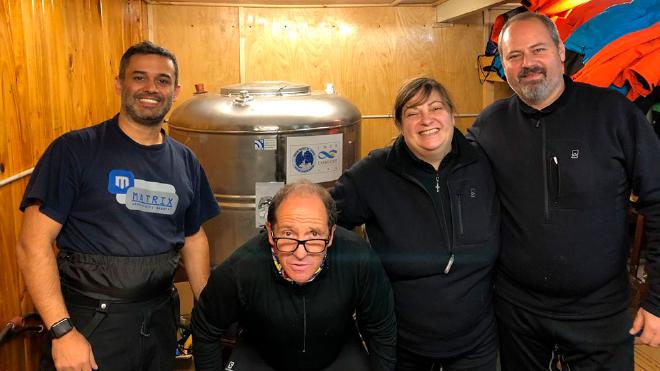
Los rayos cósmicos son partículas subatómicas que viajan a través del espacio a velocidades cercanas a la de la luz en el vacío. Este flujo de partículas está compuesto principalmente por protones y núcleos atómicos que todo el tiempo impactan contra la atmósfera terrestre. Al chocar con los gases atmosféricos, estas partículas desencadenan una cascada o “lluvia” de partículas secundarias. Son estas partículas resultantes las que finalmente alcanzan el suelo, permitiendo estudiarlas mediante detectores especializados en la superficie.
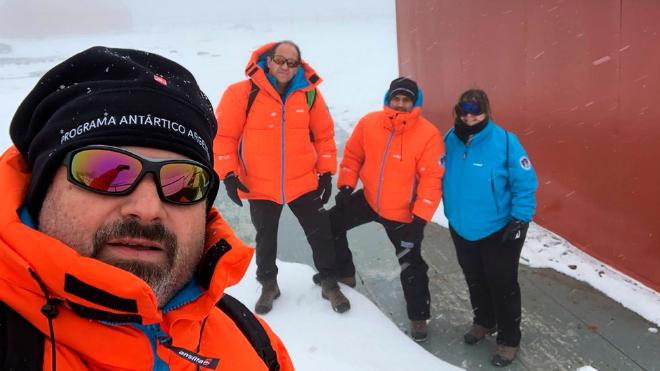
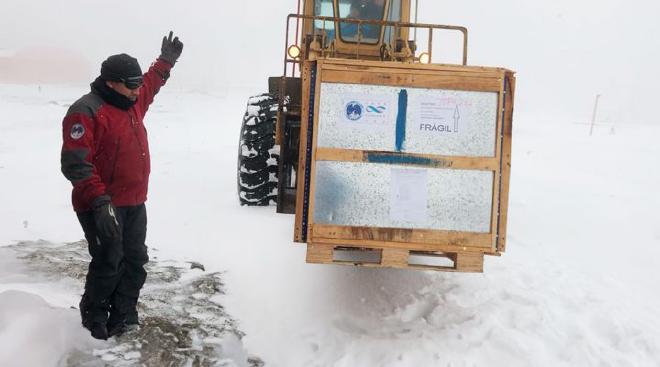
El detector Neurus #
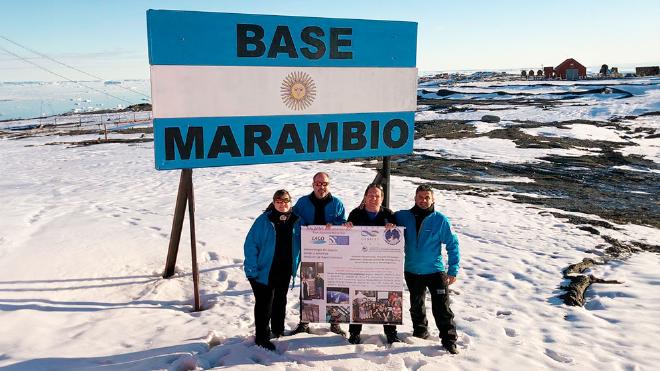
En la actualidad, Neurus registra unas 600 mil partículas por hora. “Debido a este gran volumen de información y a las limitaciones de conectividad, los datos se almacenan localmente en la Antártida y solo se transmite una síntesis procesada al continente en tiempo real”, indicó Dasso.
Nodos antárticos: Marambio y San Martín #
Desde hace dos años, el proyecto cuenta con un segundo nodo operativo en la Base San Martín. **“Aunque el análisis de estos datos está en curso, los resultados preliminares son muy prometedores. La comparación del flujo de partículas entre ambos observatorios (separados por aproximadamente 700 km) nos permitirá realizar validaciones y estudios de correlación espacial para entender mejor la dinámica de la radiación en diferentes puntos de la península antártica”, explicó Dasso.
Un tal Neurus #
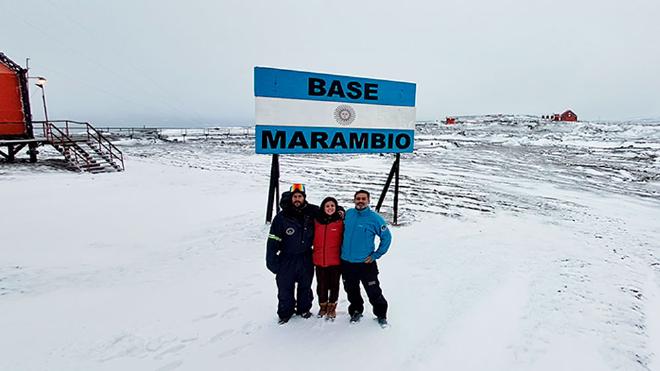
Neurus es un nodo antártico de la colaboración internacional LAGO* (Latin American Giant Observatory), una red de detección que se extiende desde México hasta la Antártida, un proyecto que derivó del Observatorio Pierre Auger, que se halla en Malargüe, provincia de Mendoza. El proyecto Antártico Neurus es liderado por el Instituto de Astronomía y Física del Espacio (IAFE, UBA-CONICET), en colaboración con el Instituto Antártico Argentino (IAA) y el Departamento de Ciencias de la Atmósfera y los Océanos (DCAO-FCEN, UBA).
La fase actual del proyecto Neurus requirió una coordinación compleja que abarcó varias etapas críticas. Una fue de Desarrollo Tecnológico: El detector fue construido íntegramente en los laboratorios espaciales del IAFE, mejorando diseños previos de este tipo de detectores. Se realizaron estudios atmosféricos específicos en colaboración con el DCAO para entender el entorno del sitio.
“En cuanto a la Logística Antártica se articuló con el IAA para el despliegue de las campañas, la adecuación edilicia, la instalación del laboratorio en el continente blanco y la presencia permanente de personal de mantenimiento en las bases”, explicó Dasso.
“Este desarrollo es pionero y original, ya que no existen otros observatorios de estas características operando actualmente en suelo antártico. Los resultados que encontramos consolidan una perspectiva innovadora: el uso de los rayos cósmicos como sensores ambientales de precisión, abriendo nuevas vías para monitorear y entender mejor componentes antárticas de la circulación global y los desafíos que plantea la evolución del clima desde la física de frontera”, afirmó Santos.
En tanto, Dasso concluyó que “este trabajo es la culminación de un camino institucional que comenzó hace más de 15 años, cuando nuestro grupo en el IAFE impulsó la instalación de detectores de rayos cósmicos en bases antárticas argentinas”.
Cita #
- El estudio Cosmic ray counting variability from water‐Cherenkov detectors as a proxy of stratospheric conditions in Antarctica (Variabilidad del conteo de rayos cósmicos de los detectores de agua Cherenkov como indicador de las condiciones estratosféricas en la Antártida), fue publicado en la revista **Earth and Space Science, 12(11), e2025EA004298. Autores: Santos, N. A., Gómez, N., Dasso, S., Gulisano, A. M., Rubinstein, L., Pereira, M., … & LAGO Collaboration. (2025)**
Resumen de la selección de papers destacados realizada por los editores de AGU (publicados en EOS-AGU) : Linking Space Weather and Atmospheric Changes With Cosmic Rays, by Graziella Caprarelli – 12 February 2026
Dasso, S., Santos, N. A., Gulisano, A. M., Pereira, M., Rubinstein, L., & Areso, O. (2025). Daily cosmic ray counting and barometric pressure at ground level observed at Antarctic Peninsula (Marambio station) [Dataset]. Zenodo. https://doi.org/10.5281/zenodo.14900672
Contacto [Notaspampeanas](mailto: notaspampeanas@gmail.com)