


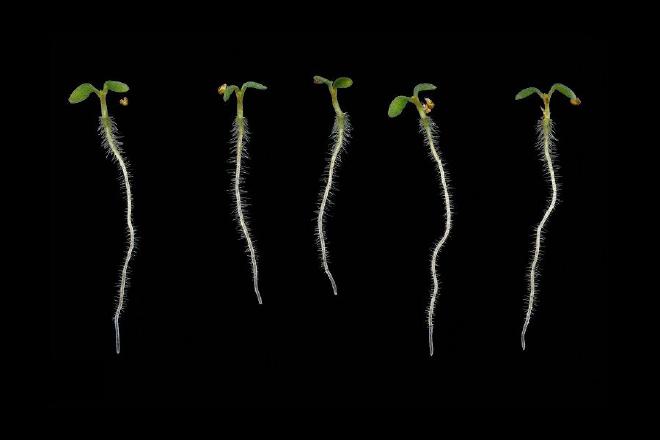
Hace más de cien años, el botánico alemán Karl Hecht documentó cómo las membranas de las células vegetales se desprendían de la pared celular al carecer de agua. Sin embargo, partes de la membrana permanecían adheridas a la pared, creando una extraña red de puntos de anclaje que se conoció como «estructuras hechtianas». El material y la función de estas estructuras desconcertaron a los científicos hasta hace poco.
El estudio, publicado hoy en la revista Cell, describe cómo la “máquina molecular” que construye la pared celular también crea estos puntos de anclaje cruciales en la membrana. Para lograr este análisis exhaustivo de las estructuras, el autor principal y becario postdoctoral Yue Rui examinó las células de las raíces de las plantas mediante imágenes de células vivas, mapeo de proteínas y comparación de mutaciones genéticas.
«Me resulta muy satisfactorio tomar un proceso que se ha caracterizado durante más de 100 años y establecer su base molecular», dijo José Dinneny, profesor de biología en la Facultad de Humanidades y Ciencias de Stanford, y autor principal del estudio. «Las imágenes son hermosas y la capacidad de Yue para detectar cambios a escala muy fina en la estructura celular ha sido un placer y un regalo para observar», dijo.
Cómo hacer “monitoreos de mutantes” #
Rui comenzó a explorar el propósito de las estructuras hechtianas comparando las respuestas al estrés hídrico entre variedades silvestres y genéticamente mutadas de Arabidopsis, una pequeña planta silvestre con muchas similitudes con cultivos comunes de alimentos y bioenergía. Al igual que las células de nuestro propio cuerpo, las células vegetales están definidas por una membrana plasmática que contiene los componentes internos que realizan funciones celulares importantes. Además, las células vegetales están encerradas en una pared celular, como “un globo en una caja”, según Dinneny. Normalmente, el globo se infla con agua y sustancias disueltas que presionan contra la pared. Cuando la célula vegetal se expone al estrés y pierde agua, es como si se liberara la presión del globo. Sin embargo, en las células vegetales, la membrana no se separa por completo y partes del globo permanecen unidas a las paredes de la caja.
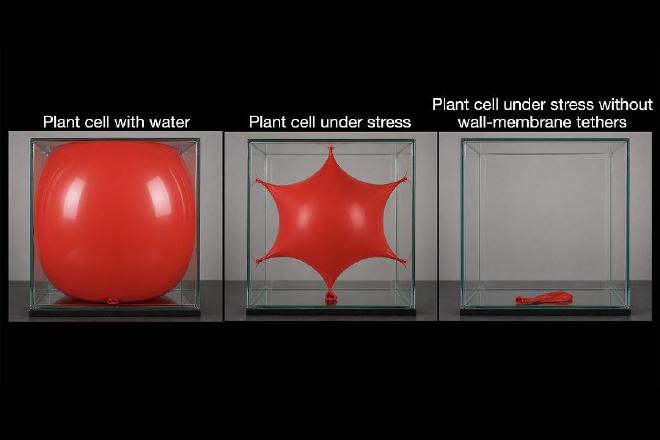
Una célula vegetal puede modelarse como un globo dentro de una caja, donde la membrana plasmática y el contenido celular interno representan el globo y su contenido, y la pared celular es la caja de cristal. En condiciones normales, el globo se encuentra presionado contra la pared celular y se mantiene en su lugar mediante las conexiones entre la pared celular y la membrana. Bajo estrés hídrico, el agua sale de la célula, modelada aquí como un globo parcialmente desinflado, pero que permanece parcialmente inflado debido a la presencia de los puntos de anclaje. Sin embargo, cuando se eliminan estos puntos de anclaje, la célula pierde más agua, modelada aquí como un globo que se desinfla por completo. | José Dinneny usando ChatGPT
«Las imágenes obtenidas mediante crio-ET en este artículo reflejan las técnicas más avanzadas para explorar la biología celular a escala nanométrica», afirmó Dinneny. «Por lo tanto, este artículo cierra de forma excelente la historia de la utilización de la microscopía avanzada en biología, desde las observaciones iniciales de Karl Hecht hasta las observaciones de estructuras hechtianas mediante crio-ET».
Tejiendo resiliencia #
Rui observó que las plantas capaces de mantener un mayor número de filamentos durante situaciones de estrés se recuperaban mucho mejor que aquellas con menos filamentos.
Las CSC actúan como tejedoras a nanoescala, tejiendo un hilo de celulosa alrededor de la célula como un capullo. Mientras la CSC deposita los hilos de celulosa, también une la membrana a la pared celular durante el proceso de tejido. Las REM, por otro lado, actúan como una mano que los desenrolla, controlando cuántas puntadas se mantienen en cada momento. Cuando falta una REM, aumenta el número de CSC en la membrana, anclándola con mayor firmeza a la pared celular durante situaciones de estrés. Identificar la función de cada proteína en esta estrategia de supervivencia abre posibilidades para la bioingeniería de mejores cultivos. La pérdida de agua celular se produce en condiciones de sequía, salinidad, calor y congelamiento, por lo que comprender cómo las células vegetales afrontan esta pérdida de agua es más urgente que nunca a medida que los cambios climáticos se vuelven más severos.
El futuro #
“Para mí, la siguiente línea de investigación interesante es observar este mecanismo en especies aún más tolerantes a la sequía y comprobar si presentan puntos de unión a la membrana más estables o más densos”, afirmó Rui. Los estudios futuros también podrían incluir el análisis de estas uniones en Arabidopsis en diferentes etapas de su ciclo de vida, como en semillas secas que pueden permanecer almacenadas durante años y aun así germinar posteriormente.
En general, a Dinneny le fascina descubrir que estas células vegetales utilizan la celulosa tanto como material de construcción como elemento vital.
Naturaleza creativa #
Cita #
- El estudio Plant cell wall-plasma membrane attachments mediate stress resilience through cellulose synthase complexes and remorins (Las uniones entre la pared celular vegetal y la membrana plasmática median la resistencia al estrés a través de complejos de celulosa sintasa y remorinas) fue publicado en la revista Cell. Autores: Yue Rui, Magda Zaoralová, William P. Dwyer, Andrés V. Reyes, Tarabryn S. Grismer, Nikolaj B. Abel, Dharanidaran Jayachandran, Shishir P.S. Chundawat, Thomas Ott, Joseph J. Kieber, Peter D. Dahlberg, Shou-Ling Xu, José R. Dinneny
Otros coautores pertenecen a la Institución Carnegie para la Ciencia, la Universidad de Aarhus, la Universidad de Rutgers, la Universidad de Friburgo y la Universidad de Carolina del Norte. Dahlberg también es investigador principal en el Instituto PULSE** de **Stanford y miembro de Stanford Bio-X y del Instituto de Neurociencias Wu Tsai. Dinneny también es investigador en el Instituto Médico Howard Hughes y miembro de Stanford Bio-X.
Financiación #
- Esta investigación fue financiada por la Fundación para la Investigación en Ciencias de la Vida, el Departamento de Energía, los Institutos Nacionales de Salud, el Instituto Nacional de Ciencias de Medicina General de los Estados Unidos, el Instituto Stanford Precourt para la Energía, la Fundación Simons, el Instituto Médico Howard Hughes, la Fundación Alemana de Investigación, la Fundación Nacional de Ciencias de Estados Unidos y el fondo de dotación Carnegie para las instalaciones de espectrometría de masas Carnegie.
Contacto [Notaspampeanas](mailto: notaspampeanas@gmail.com)