

  1. Posts/

Scientists discover, in La Rioja ,a gigantic distant relative of crocodiles that lived 237 million years ago

·5 mins·
Notaspampeanas
Palaeontology Argentina La Rioja Talampaya Middle-Late Triassic Paracrocodylomorpha Shakajlura Riojanensis Blessed Lizard of La Rioja CONICET Ariel Cardillo Julia Brenda Desojo María Belén Von Baczko Martín Ezcurra Agustín Martinelli Nahuel Vega Lucas Fiorelli CRILAR FCNyM
Notaspampeanas
Author
Notaspampeanas
Digging on curiosity and science.
Table of Contents

A CONICET research team, from Argentina, discovered a reptile in La Rioja that reached 6 meters in length and had a 60-centimeter skull. It inhabited the present-day Talampaya region and was one of the main and most ferocious predators of the Triassic period, long before the appearance of the large carnivorous dinosaurs.

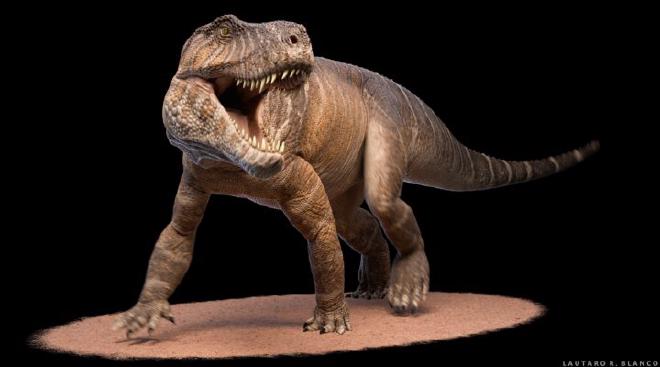
Reconstruction of Shakajlura in life. Paleoartist: Lautaro Rodríguez Blanco.

During the Middle-Late Triassic, around 237 million years ago, when the large carnivorous dinosaurs did not yet exist, reptiles of the Paracrocodylomorpha group —quadrupeds between 4 and 10 meters long—distant relatives of modern crocodiles, were the largest and most fearsome predators. In a paper published today in the journal Papers in Palaeontology, a research team from CONICET, made up of experts from La Plata, La Rioja, and the Autonomous City of Buenos Aires (CABA), reported the discovery of a new genus and species of paracrocodylomorph: Shakajlura riojanensis, meaning “blessed lizard of La Rioja.”

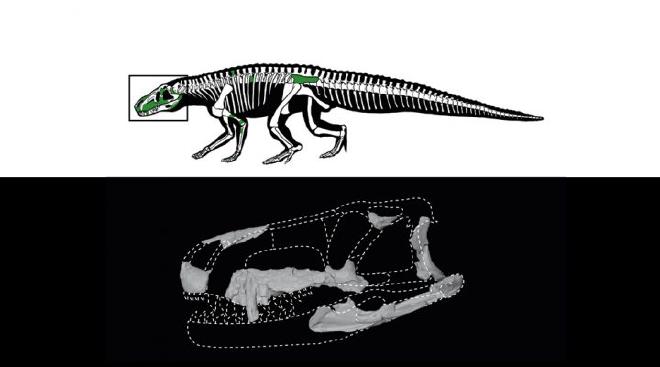
Reconstruction of the location of the skull and hip bones found. Photo: Cardillo et al..

In an CONICET’s article, signed by Marcelo Gisande, made an announcement about a discovery that was made in the Chañares Formation, located in Talampaya National Park, during two paleontological expeditions carried out in 2017 and 2018 by the Archosauriform Research Group. It consisted of the discovery of several skull and postcranial bones, including pieces from the animal’s waist. This animal reached a length of 6 meters and had a skull measuring 60 centimeters. “The Chañares Formation is a window that shows us what the world was like between 237 and 233 million years ago,” said Ariel Cardillo, a CONICET doctoral fellow at the Regional Center for Scientific Research and Technological Transfer of La Rioja (CRILAR, CONICET-UNLaR-SEGEMAR-UNCa-Government of La Rioja) and first author of the study.

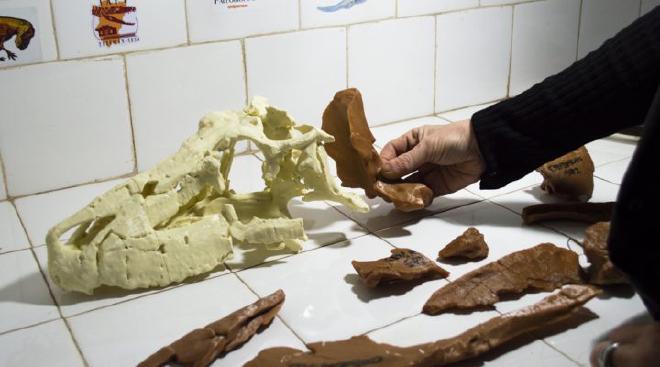
Pieces of the Shakajlura skull. Photo: CONICET Photography/R. Baridón.

“The Triassic is a key moment in the history of life on Earth: it began after the Great Dying, as the largest mass extinction on record—the Late Permian extinction, 252 million years ago—is known, and it is the first period of the so-called ‘Age of Reptiles,’ that is, the Mesozoic Era. In that sense, the outcrops of the Chañares Formation present a record of global interest because they include ancestors of mammals, dinosaurs, and crocodiles, as well as plants, fungi, and arthropods,” Cardillo pointed out.

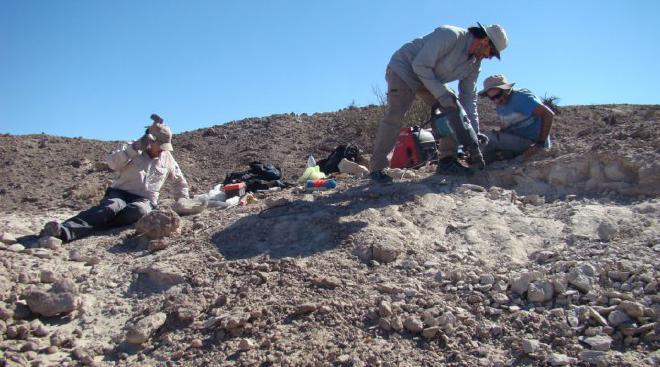
Collection campaign in the Chañares Formation. Photo: Cardillo et all.

Trained at the Faculty of Natural Sciences and the Museum of the National University of La Plata (FCNyM, UNLP), Cardillo emphasized that “Paracrocodylomorpha are important for several reasons. On the one hand, they tell us about the origin of crocodiles, the only representatives of the lineage that have survived to the present day. On the other hand, they provide information about what those Triassic faunas were like after the Permian extinction. Furthermore, they are considered the ‘rare finds’ because very few specimens have been found compared to other animal groups from the same period, so every time a new one is discovered, it has immense scientific value.”

Indeed, until the discovery of Shakajlura, only one fossil specimen was known for the group extracted from the Chañares Formation: Luperosuchus fractus, originally studied by the American paleontologist Alfred Romer in the early 1970s. “The general morphology and the stratigraphic level in which Shakajlura was collected, contemporary with that of Luperosuchus, suggest close affinities between them. However, there are considerable differences in the shape of the snout and some bones surrounding the eye,” stated Julia Brenda Desojo, a CONICET researcher at the FCNyM and also an author of the publication.

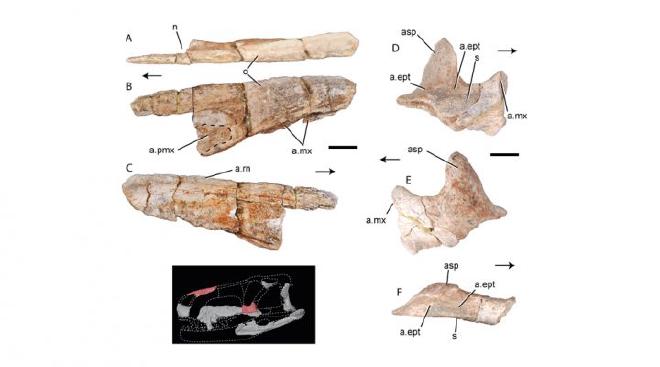
Reconstruction of Shakajlura’s skull. Photo: Cardillo et al.
Reconstruction of Shakajlura’s skull. Photo: Cardillo et al..

“Luperosuchus has an upward curve or projection, like a prominent little mountain above the snout, at the level of the nostrils, something not seen in Shakaljura,” Desojo pointed out, and joked, “A kind of Roman nose.” The new specimen has perfectly straight nasal bones. “On the other hand, there is a distinctive feature that clearly separates them in a bone located at the back of the orbit, called the postorbital bone: while in Luperosuchus it has a rounded protuberance, in Shakaljura it is more like an elongated bar,” he explained.

Julia Brenda Desojo, CONICET researcher at the FCNyM. Photo: CONICET Photography/R. Baridón.

Another characteristic of the new specimen is the almost complete absence of ornamentation on the maxilla, the upper jawbone that holds the teeth, unlike that found in modern crocodiles. “This one is quite smooth in every way,” Cardillo remarked, noting that this characteristic distinguishes it from several other members of the group worldwide. It’s worth highlighting that Paracrocodylomorpha were known to inhabit every continent except Antarctica and Australia at that time in history.

“Another characteristic that makes it unique is the shape of one of its jaw bones, the prearticular bone, which has different proportions compared to all its close relatives. Because of all these unique characteristics, which distinguish it from other Paracrocodylomorpha , we are talking about a new genus and species,” explained the CONICET fellow. Finally, the researchers emphasized that Shakajlura is the first specimen of this group described in Argentina since 1997.

Citation
#

In addition to Cardillo and Desojo,* the research team includes: María Belén von Baczko, Martín Ezcurra and Agustín Martinelli, CONICET researchers at the Argentine Museum of Natural Sciences “Bernardino Rivadavia” (MACNBR, CONICET); Nahuel Vega, researcher at the National Atomic Energy Commission (CNEA), and Lucas Fiorelli, CONICET researcher at CRILAR.

  • The study A new large paracrocodylomorph archosaurian from the Tarjadia Assemblage Zone (upper Ladinian to lower Carnian) of the Chañares Formation (Argentina) and a revision of key loricatan features was published in Papers in Palaeontology

Cardillo, A.F., Desojo, J.B., von Baczko, M.B., Ezcurra, M.D., Martinelli, A.G., Vega, N. and Fiorelli, L.E. (2026), A new large paracrocodylomorph archosaurian from the Tarjadia Assemblage Zone (upper Ladinian to lower Carnian) of the Chañares Formation (Argentina) and a revision of key loricatan features. Pap Palaeontol, 12: e70086. https://doi.org/10.1002/spp2.70086


Contact [Notaspampeanas](mailto: notaspampeanas@gmail.com)


Related

CONICET scientists find a new 70-million-year-old reptile in Argentine Patagonia
·6 mins
Notaspampeanas
CONICET Paleoteius Lakui MACN Federico Agnolin Martín Ezcurra Paleoteius Late Cretaceous Argentine Patagonia National Geographic Society Paleontology Laboratory of Comparative Anatomy and Vertebrate Evolution Argentine Museum of Natural Sciences Río Negro Scientific Reports Allen Formation Yacimiento De Salitral Ojo De Agua Fundación Félix De Azara Gondwana Pangaea Scincomorpha High-Performance Computing Center National University of Cordoba
CONICET team develops a device for domestic use to remove micro and nanoplastics from water
·4 mins
Notaspampeanas
Microplastics Nanoplastics INTEMA CONICET UNMdP Science of Materials Technology of Materials 2025 Franco-Argentine Innovation Award Carla Di Luca Materials Development
Cosmic rays and atmospheric changes: An innovative study by CONICET scientists in Antarctica
·6 mins
Notaspampeanas
Cosmic Rays Atmospheric Changes Antártida Neurus LAGO Collaboration CONICET IAFE Scientific Research Cherenkov Radiation Marambio Joint Antarctic Base San Martín Base Argentine Antarctic Institute Sergio Dasso Noelia Santos Atmospheric Sciences Particle Physics
Argentina: Tick-borne bacteria detected in wildlife
·4 mins
Notaspampeanas
Argentina INTA Zoonosis Ehrlichia Chaffeensis Ciervo De Los Pantanos Fauna Silvestre
CONICET scientists will once again explore the depths of the Argentine Sea aboard the Falkor
·9 mins
Notaspampeanas
Oceanography Continental Slope v Mission Argentine Biology Ameghino & Almirante Brown Canyons Schmidt Ocean Institute CONICET Southwest Atlantic Institute of Biology of Marine Organisms Argentine Deep Sea Studies Group Argentine Universities
El Niño confirmed: INTA warns about opportunities and risks for the 2026/27 campaign
·5 mins
Notaspampeanas
Argentina INTA El Niño El Niño-Southern Oscillation ENSO Pablo Mercuri Center for Natural Resources Research Natalia Gattinoni Meteorology INTA Climate and Water Institute