


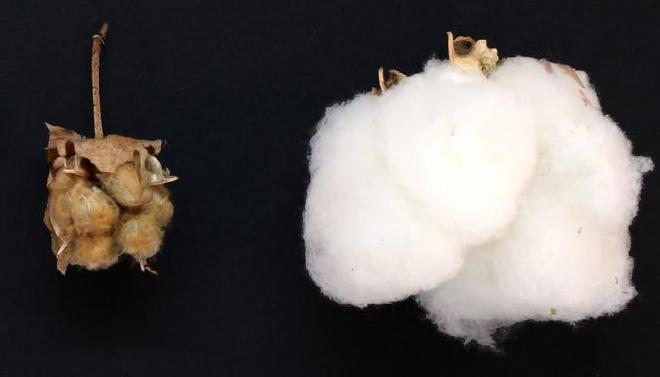
¿Cómo llegamos de allí a aquí? Wendel, un distinguido profesor de ecología, evolución y biología de organismos en la Universidad Estatal de Iowa, lleva décadas haciéndose esa pregunta.
Wendel y un equipo de 19 coautores esbozaron una respuesta en un artículo publicado en las Actas de la Academia Nacional de Ciencias, que revela que muestras de plantas silvestres recolectadas recientemente y un análisis avanzado de datos de secuenciación genómica confirman que el algodón moderno fue domesticado a partir de una población diversa originaria de la península de Yucatán en México.
“Cuando los humanos domestican una planta, seleccionan entre una gran población y el resto se descarta. Si se repite este proceso durante 1000 generaciones, la base genética resultante es muy reducida”, explicó Wendel. “Por eso nos interesa tanto la diversidad genética silvestre. Queremos saber qué especies aún existen”.
Colecciones elaboradas a lo largo de los años #
No fue ninguna sorpresa que el origen del algodón moderno se encontrara en Yucatán. Estudios anteriores de Wendel, un destacado experto en genética del algodón, habían utilizado métodos menos precisos para sugerir que la península que se curva hacia el norte en el sureste de México era un posible origen de la domesticación de la planta, un proceso que comenzó hace unos 5.000 años.
“Si todo lo que ves presenta una variación novedosa y sorprendente, es evidente que aún no has alcanzado la saturación. Pero si los siguientes diez elementos se parecen al último que elegiste y todo forma un grupo compacto y ordenado, ¿para qué seguir duplicando elementos?”, dijo Wendel.
“Nuestros colaboradores hicieron un trabajo increíble tomando muestras estratégicamente en toda la península de Yucatán, y una vez que tuvimos esos datos de secuenciación, quedó muy claro de dónde provenían”, dijo.
Los investigadores compararon cientos de genomas de algodón de diferentes maneras para validar sus hallazgos, incluyendo la cuantificación de las diferencias entre genomas individuales y la identificación de los más similares. Según Grover, este análisis relacionó los genomas del algodón doméstico con los especímenes del extremo noroeste de Yucatán.
Aprovechar plantas antiguas para obtener nuevos beneficios #
La diversidad genética que quedó en estado silvestre tras miles de años de selección artificial por parte del ser humano se concentra principalmente en el lugar de origen del algodón, ya que la domesticación crea un cuello de botella genético, reduciendo el acervo genético en las generaciones sucesivas. Los investigadores descubrieron que los genomas de dos plantas de algodón silvestre elegidas al azar del noroeste de Yucatán presentan, en promedio, el doble de diferencias genéticas que dos cultivares modernos elegidos al azar.
“Resulta que el algodón cultivado surgió de un cuello de botella genético muy pequeño”, explicó Wendel.
“Sabemos que existen rasgos genéticos en las poblaciones silvestres que podrían ser útiles si logramos identificarlos e incorporarlos al algodón domesticado”, afirmó. “Ahora contamos con todos estos datos de Yucatán, y están listos para ser analizados”.
Cita #
- El estudio Genomic diversity and the domestication history of cotton Gossypium hirsutum (Diversidad genómica e historia de la domesticación del algodón Gossypium hirsutum) fue publicado en las Actas de la Academia Nacional de Ciencias (PNAS)
Genomic diversity and the domestication history of cotton (Gossypium hirsutum) Weixuan Ning, Mark A. Arick, II, Joshua A. Udall, Chuan-Yu Hsu, Luis Abdala-Roberts, Uriel Solís-Rodríguez, Yeyson Briones-May, Zenaida V. Magbanua, Olga Pechanova, Carlos Bustos-Segura, Mary V. Clancy, Sandra Díaz-Cruz, Alejandra Garnica-Cabrera, Marine Mamin, John Z. Yu, Ted C. J. Turlings, Guanjing Hu, Daniel G. Peterson, Corrinne E. Grover, corrinne@iastate.edu, and Jonathan F. Wendel jfw@iastate.edu Authors Info & Affiliations Contributed by Jonathan F. Wendel; received February 26, 2026; accepted April 20, 2026; reviewed by Brandon S. Gaut and Michael D. Purugganan May 18, 2026 123 (21) e2607107123 https://doi.org/10.1073/pnas.2607107123
Contacto [Notaspampeanas](mailto: notaspampeanas@gmail.com)