


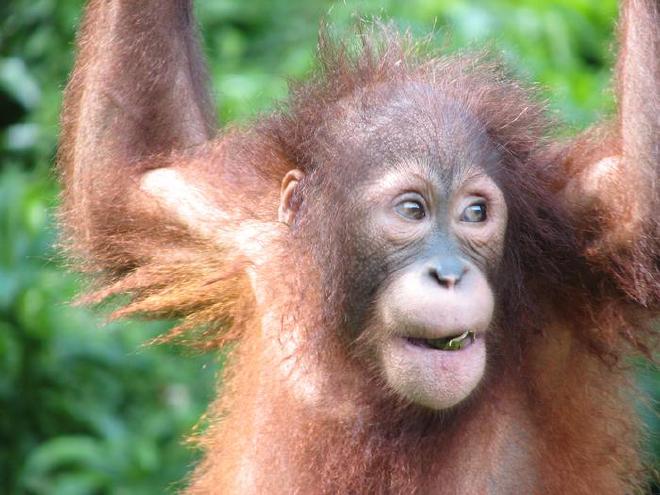
All living great apes - chimpanzees, bonobos, gorillas, and orangutans - laugh. But until now, it has been unclear how our laughter may have changed over millions of years of evolution, and how it might relate to the evolution of speech in humans.
The researchers propose this basic rhythmic structure was already present in a shared common ancestor 15 million years ago and has remained remarkably conserved with all living great apes still show the same underlying pattern.
The researchers found that while the basic rhythm stayed constant, human laughter has become faster, more variable, and gained sophisticated context-dependent control. Of the great apes, humans alone have the ability to control when and how they laugh depending on context: an uncontrollable laugh when tickled differs sharply from a polite laugh in a meeting, a nervous laugh after a mistake, or the infectious laughter that spreads through a group of friends. The same underlying rhythm, shaped by conscious control to communicate different emotions and intentions.
Dr Adriano Lameria, Associate Professor, ApeTank, Department of Psychology, University of Warwick said: “It is impossible to assess the precursor forms of language directly from our extinct ancestors. Laughter, being evolutionarily older and having remained shared between all living great apes, provides a rare evolutionary window into the vocal transformations that unfolded across hominid evolution until the first humans appeared on scene. Contrary to the classic notion that the first humans suddenly acquired vocal control capacities remarkably different from their predecessors, laughter evolution tells us that humans lay on a continuum, a prolongation of vocal control capacities that were already being cumulatively honed in for 15 million years.”
Citation #
The paper ‘Rhythm and timing in laughter reveal that human vocal plasticity falls on a hominid continuum’ is published in Communications Biology. DOI: 10.1038/s42003-026-10499-z. Authors: Chiara De Gregorio, Marina Davila-Ross & Adriano R. Lameira
De Gregorio, C., Davila-Ross, M. & Lameira, A.R. Rhythm and timing in laughter reveal that human vocal plasticity falls on a hominid continuum. Commun Biol 9, 824 (2026). https://doi.org/10.1038/s42003-026-10499-z
Received 17 November 2025
Accepted 05 June 2026
Published 25 June 2026
Version of record 25 June 2026
DOI https://doi.org/10.1038/s42003-026-10499-z
Contact [Notaspampeanas](mailto: notaspampeanas@gmail.com)