


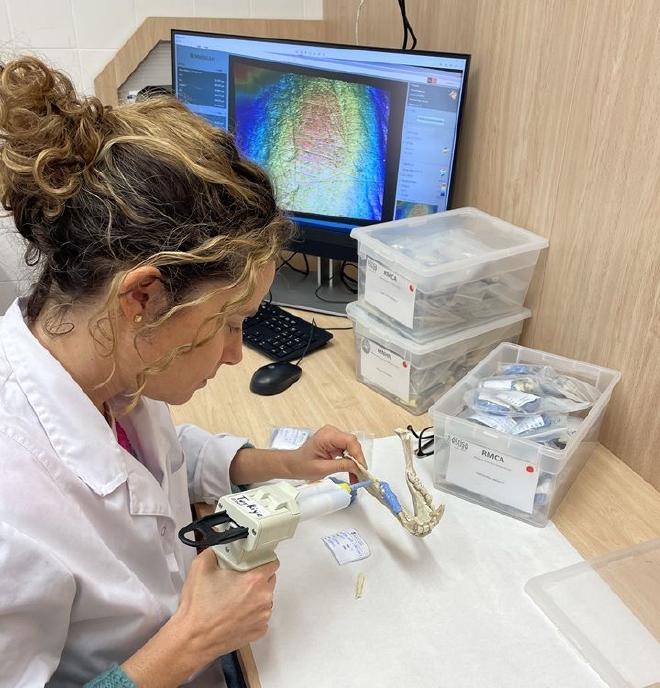
En paleoantropología, esta metodología ayuda a reconstruir la dieta de primates y homininos fósiles a lo largo de la evolución humana. Las estrías microscópicas que contiene el esmalte dental son como archivos microscópicos que revelan si en la dieta abundaban alimentos con componentes más blandos o más abrasivos.
Estos patrones de desgaste en 3D difieren entre primates que habitan ecosistemas diversos y que presentan dietas distintas. El trabajo identifica también qué variables son más informativas para la clasificación del microdesgaste dental, y propone un esquema analítico abierto a toda la comunidad científica para estudiar este tipo de superficie.
El estudio los cambios medioambientales a través del microdesgaste dental #
El estudio del microdesgaste dental tiene una larga trayectoria en los estudios sobre el origen y la evolución del linaje humano. «Hasta ahora, se habían utilizado a menudo medidas de desgaste más sencillas, habitualmente en 2D, mediante técnicas de estadística convencional que establecían relaciones relativamente directas entre estos parámetros y la dieta», detalló Laura M. Martínez, del Departamento de Biología Evolutiva, Ecología y Ciencias Ambientales de la UB.
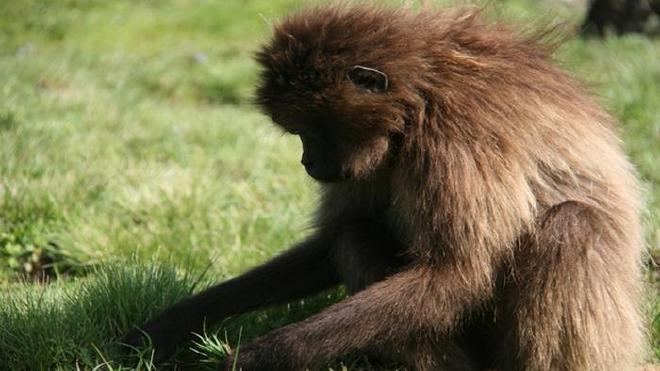
«Para reconstruir la dieta de primates y homininos fósiles, es imprescindible disponer de buenos modelos comparativos basados en primates actuales y poblaciones cazadoras-recolectoras de dieta conocida», añadió Martínez. «Con la incorporación de técnicas 3D, se ha podido generar una cantidad muy elevada de variables, lo que dificulta su interpretación con estadística convencional. En este contexto, la IA facilita la integración y compresión de esta información compleja, permitiendo así identificar patrones en superficies 3D que no son fácilmente interpretables de forma directa», detalló la investigadora.
El proyecto se centra especialmente en los cercopitécidos —una familia extensa de primates presente en distintos hábitats— del norte, este y sur de África, procedentes de yacimientos datados entre 4 y 1 millón de años. Durante este periodo, se produjeron cambios climáticos importantes que afectaron profundamente a los ecosistemas africanos. El objetivo es analizar, en relación con el cambio climático, la evolución de la dieta en estos primates, que además coexistieron en el tiempo y el espacio con los primeros homininos.
«Los cercopitécidos vivieron en los mismos ecosistemas y en la misma cronología que los homininos, lo que los convierte en un modelo excelente para entender cómo los cambios climáticos del Plio-Pleistoceno impactaron en la dieta y adaptación de estos primates», detalló la investigadora.
En el futuro, el equipo quiere ampliar significativamente el tamaño de la muestra para mejorar la precisión y robustez del modelo. Por eso, se están incorporando más muestras de diferentes especies y de ecosistemas diversos, con dietas bien caracterizadas, así como otros factores ecológicos, para hacer más consistente el análisis.
Cita #
- El estudio experimental Machine learning approaches to dietary classification from dental microtexture in primates fue publicado en Scientific Reports. Autores: Ferran Estebaranz-Sánchez, Kristina Kit, Juan José Ibáñez Estevez, David R. Insua, Simón Rodríguez Santana & Laura M. Martínez
Estebaranz-Sánchez, F., Kit, K., Ibáñez Estevez, J.J. et al. Machine learning approaches to dietary classification from dental microtexture in primates. Sci Rep (2026). https://doi.org/10.1038/s41598-026-47350-8
Received 15 September 2025
Accepted 31 March 2026
Published 28 April 2026
DOI https://doi.org/10.1038/s41598-026-47350-8
- El artículo IA para reconstruir la dieta de los antepasados de la especie humana fue publicado en el sitio web de la Universidad de Barcelona.
Contacto [Notaspampeanas](mailto: notaspampeanas@gmail.com)