


  1. Posts/

Researchers reveal new clues about Homo erectus evolution while advancing paleoproteomics

·3 mins·
Notaspampeanas
Ancient Hominins Institute of Vertebrate Paleontology and Paleoanthropology Chinese Academy of Sciences Homo Erectus Paleoproteomics East Asian H. Erectus FU Qiaomei Zhoukoudian Hexian Denisovans Enamel Protein AMBN-A253G Mutation
Notaspampeanas
Author
Notaspampeanas
Digging on curiosity and science.
Table of Contents

Scientists from the Institute of Vertebrate Paleontology and Paleoanthropology (IVPP) of the Chinese Academy of Sciences have uncovered new information suggesting a potential connection between Homo erectus and modern humans, while also developing new, less invasive paleoproteomics methods of fossil research.

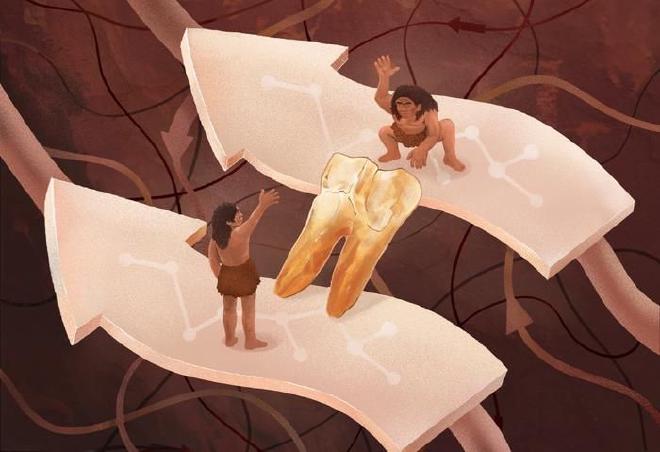
A cartoon illustration of the AMBN enamel protein. Image credit: IVPP

Homo erectus, or H. erectus, was the first species within the genus Homo to leave *Africa, occupying a key position in human evolutionary history. However, due to the lack of molecular evidence from H. erectus, their genetic characteristics, population diversity, and especially their potential connections to modern humans remain unresolved. As a result, the role of H. erectus represents a major mystery and a focal point of debate in human evolution.

Molecular research on H. erectus remains has been limited because ancient human fossils are irreplaceable and a precious cultural heritage. For this reason, traditional destructive sampling methods are unacceptable and have long constrained the progress of relevant molecular research.

Now, however, the research team, led by FU Qiaomei from IVPP in collaboration with multiple institutions, has overcome this bottleneck by employing a micro-destructive sampling approach based on acid etching to recover molecular information from six Homo erectus teeth without damaging their morphology. The findings were published today in Nature

The article was also accompanied by a concurrent commentary in Nature, which highlighted the role of enamel proteins from these six H. erectus teeth from China in providing “new insights into how ancient genetic material was eventually introduced into modern human populations.”

Two mutations
#

The researchers identified two mutations from the fossil teeth, dating back to at least 400,000 years ago, from three different sites—Zhoukoudian (Peking Man), Hexian, and Sunjiadong. The mutations suggest genetic links between East Asian H. erectus and Denisovans, which themselves are linked to modern humans.

The first is the previously unknown AMBN-A253G mutation, which was identified as a potential molecular marker associated with these H. erectus populations. It provides the first evidence that H. erectus specimens from these three sites belonged to the same evolutionary population.

The second is the AMBN-M273V variant, previously thought to be specific to Denisovans. However, this study reveals that this variant is not unique to Denisovans but is shared by these H. erectus populations.

According to the researchers, the second variant may have entered the Denisovan lineage through admixture and was subsequently passed to some modern human populations (in Southeast Asia and Oceania) via Denisovan introgression. This provides the first insights into a possible connection between East Asian H. erectus (such as those from Zhoukoudian) and Denisovans, as well as the potential deep genetic links to some present-day modern humans.

Additionally, the study establishes a suite of new experimental and computational methodologies, including a sex determination method for ancient hominins based on the male-specific enamel protein AMELY, a cross-validation approach using tandem mass spectrometry and multiple data analysis pipelines, and DNA analysis methods linked to specific amino acid variants. Together, these tools provide a new framework for systematic paleoproteomics research.

Citation
#

  • The article Enamel proteins from six Homo erectus specimens across China was published in Nature. Authors: Qiaomei Fu, Zhongyou Wu, E. Andrew Bennett, Song Xing, Qiang Ji, Zhe Dong, Huiyun Rao, Xuejun Gu, Yizhao Dang, Jun Xing, Kai Zhou & Xiaotian Feng

Funding
#

This work was supported by the National Natural Science Foundation of China (L2424324), the Chinese Academy of Sciences (CAS) (YSBR-019), the Archaeological Talent Promotion Program of China (2024-278) and the New Cornerstone Science Foundation.


Contact [Notaspampeanas](mailto: notaspampeanas@gmail.com)


Related

Peruvian indigenous have a digestive superpower; researchers think it may be linked to potatoes
·6 mins
Notaspampeanas
Anthropology Culture Anthropology Evolution Food Digestion Peruvian Andes Potatoes AMY1 Latin American Biological Sciences Earth Sciences
Plants walk a fine line between growth and defense
·5 mins
Notaspampeanas
Plants Sciences Plant Hormones Plant Physiology Plant Products University of California Davis Salicylic Acid Nitzan Shabek Natalie Hamada DMR6 DLO1 DAF1 GMO
How eating primes immune cells for future responses
·4 mins
Notaspampeanas
Immunology Cancer Diets Dietary Counseling T Cells Activation
Climate change a global threat to brain health, stroke experts say
·4 mins
Notaspampeanas
Health Medicine Climate Change Brain Health Stroke Risks Extreme Temperatures Temperature Variability Humidity Barometric Pressure Wildfires Dust Storms Sandstorms
Do memories form on a blank slate?
·4 mins
Notaspampeanas
Memory Formation Hippocampus Neurons Neuroscience Cells CA3 Memory Processes ISTA Jonas Group at the Institute of Science and Technology Austria Biology
The interstellar comet 3I/ATLAS was born somewhere much different from our solar system
·3 mins
Notaspampeanas
Comets Astronomy Astrochemistry 3I/ATLAS Atacama Large Millimeter/Submillimeter Array MDM