La sensibilidad del hielo antártico al cambio climático aumentó drásticamente después del cambio de la Edad del Hielo hace 1 millón de años
·5 mins·
Notaspampeanas
Capas De Hielo
Glaciología
Geología Física
Ciencias De La Tierra
Ciencias Físicas
Glaciares
Climatología
Ciencia Atmosférica
Paleoclimatología
Cambio Climático
Efectos Del Cambio Climático
Modelos Del Clima Y La Tierra
Ciencia Criosférica
Paleoclima
Hielo Antártico
Autor
Notaspampeanas
Notaspampeanas
Un nuevo estudio publicado en la revista Nature Geoscience, por investigadores del Centro IBS de Física Climática (ICCP) de la Universidad Nacional de Pusan en Corea del Sur muestra que la capa de hielo de la Antártida se volvió más sensible al cambio climático luego de un cambio importante en los ciclos de la edad de hielo de la Tierra hace aproximadamente un millón de años, proporcionando nueva información sobre cómo las capas de hielo responden al cambio climático a largo plazo.
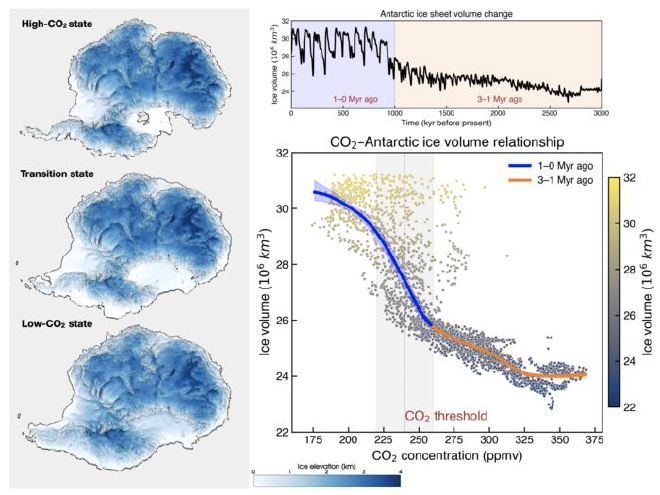
El panel muestra la simulación del modelo del cambio de volumen de la capa de hielo de la Antártida que abarca los últimos 3 millones de años. El panel inferior derecho representa la relación entre la concentración de CO₂ atmosférico y los cambios en el volumen del hielo antártico. Las líneas azul y naranja muestran ajustes no lineales para hace 1-0 millones de años y hace 3-1 millón de años, respectivamente, con bandas sombreadas que indican el rango de incertidumbre del 95%. Los mapas de la izquierda muestran cambios representativos de la elevación del hielo antártico en estados de alto, transición y bajo nivel de CO₂. Crédito de la imagen: Instituto de Ciencias Básicas.
La Antártida actualmente posee la masa de hielo más grande de la Tierra y desempeña un papel clave en el cambio global del nivel del mar. Hace aproximadamente un millón de años, el sistema climático de la Tierra experimentó un cambio importante, con edades de hielo que se hicieron más largas e intensas. Esta transición, conocida como Transición del Pleistoceno Medio, alteró fundamentalmente el comportamiento de grandes capas de hielo, sin embargo, aún no se comprende bien cómo respondieron a este cambio. Un desafío clave ha sido la falta de datos realistas y a largo plazo sobre temperatura y precipitación necesarios para ejecutar modelos de capas de hielo en tales condiciones.
Para superar esta limitación, los investigadores utilizaron una simulación paleoclimática realista por ordenador, realizada recientemente en el ICCP, que reproduce la historia del clima global durante los últimos 3 millones de años. Los datos de temperatura y lluvia de esta simulación se utilizaron luego como datos de entrada para el modelo de capa de hielo y plataforma de hielo de la Universidad Penn State. Este modelo simula cambios en el flujo, la temperatura y la altura de las capas de hielo del hemisferio norte y la Antártida. También captura la dinámica y el movimiento de las plataformas de hielo flotantes, como en los mares de Ross y Weddell. Ejecutando el modelo de la capa de hielo en una de las computadoras más veloces de Corea del Sur dedicada a la ciencia básica, los investigadores obtuvieron una representación físicamente consistente y espacialmente continua de la evolución de la capa de hielo global en condiciones climáticas que evolucionan en el tiempo.
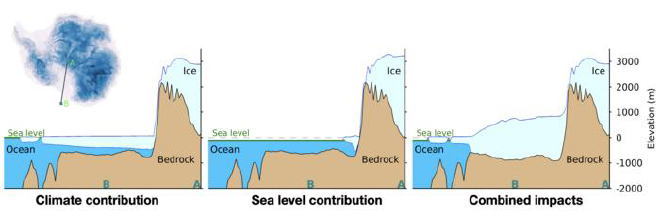
Transecto de la plataforma de hielo del Mar de Ross para condiciones de bajo CO₂, correspondiente a una alta sensibilidad a los forzamientos: (izquierda) contribución del clima, (centro) contribución del nivel del mar e (derecha) impactos combinados de los cambios climáticos y del nivel del mar. Crédito de la imagen: Instituto de Ciencias Básicas.
La simulación reveló que tras la transición del Pleistoceno medio, la capa de hielo de la Antártida entró en un nuevo régimen dinámico. En particular, los resultados identifican un nivel crítico de CO2 atmosférico de alrededor de 240 partes por millón, por debajo del cual la amplitud de las variaciones del hielo antártico aumenta repentinamente en respuesta a cambios en las temperaturas atmosféricas y oceánicas.
“Después de esta transición, la capa de hielo de la Antártida reacciona mucho más fuertemente a los cambios en el forzamiento climático. Esto indica que el sistema no evoluciona gradualmente sino que se vuelve más receptivo después de cruzar un umbral particular en el sistema climático”, dijo el Dr. YUN Kyung-Sook, investigador del Centro IBS de Física del Clima y autor principal del estudio.
En la simulación del modelo por computadora, el crecimiento acelerado del hielo antártico después de hace 1 millón de años puede atribuirse a una combinación de factores: i) temperaturas más frías del océano glacial, que reducen el derretimiento de la capa de hielo antártico por debajo del nivel del mar, ii) nivel global del mar más bajo (~50-100 m por debajo del actual), lo que reduce la presión sobre el lecho rocoso debajo de las plataformas de hielo, lo que provoca un lento levantamiento que promueve aún más el espesamiento del hielo a lo largo de la costa de la Antártida. Trabajando al unísono, estos procesos ayudaron a establecer las capas de hielo antárticas más grandes y más persistentes características de los ciclos posteriores de la edad de hielo.
“Nuestros hallazgos sugieren que la capa de hielo de la Antártida era más sensible a las fuerzas externas de lo que se suponía anteriormente. Esto también plantea importantes preguntas sobre su respuesta futura al calentamiento global”, dijo el profesor Axel TIMMERMANN, director del Centro de Física del Clima del IBS y coautor del estudio.
El estudio destaca que las capas de hielo no responden linealmente al forzamiento climático, sino que pueden sufrir cambios bruscos que alteran drásticamente su sensibilidad a factores externos. Comprender estos cambios es fundamental para mejorar las proyecciones del aumento futuro del nivel del mar.
Cita
El estudio Increased sensitivity of Antarctic Ice Sheet to decreasing CO2 across the Mid-Pleistocene Transition (Mayor sensibilidad de la capa de hielo antártica a la disminución de CO2 durante la transición del Pleistoceno medio), basado en la simulación, el modelado computacional, fue publicado en Nature Geoscience. Autores: Kyung-Sook Yun y Axel Timmermann
Yun, KS., Timmermann, A. Increased sensitivity of the Antarctic Ice Sheet to decreasing CO2 across the Mid-Pleistocene Transition. Nat. Geosci. (2026). https://doi.org/10.1038/s41561-026-01979-2