


The United Nations estimates that 2.2 billion people lack safely managed drinking water, and communities from California to the Middle East rely on desalination plants to convert ocean water to fresh water. Common desalination techniques such as reverse osmosis and thermal distillation are energy-intensive, require pre- and post-water treatment, and leave behind a concentrated saltwater byproduct called brine that wreaks havoc on sea life when it’s deposited back into the ocean by raising the salt level and lowering oxygen in the water.
The technology uses solar panels made of black metal etched with femtosecond lasers to make the surface super light absorbing and superwicking—or extremely attractive to water. The panels have a laser-treated active region that pulls a thin layer of water across the surface, absorbs nearly all solar radiation, distills the water, and deposits the leftover salts and minerals into the panel’s untreated sides or “passive” region so that the salt does not clog the active region and disrupt continuous desalination.
Leveraging the ‘coffee ring’ effect #
Guo says other researchers have developed solar-thermal desalination techniques that work well in lab experiments using simulated seawater made of only water and sodium chloride. As the water evaporates, the sodium chloride crystalizes in a grainy and porous fashion allowing water to pass through to dissolve the salt and the solar panels can be easily cleaned.
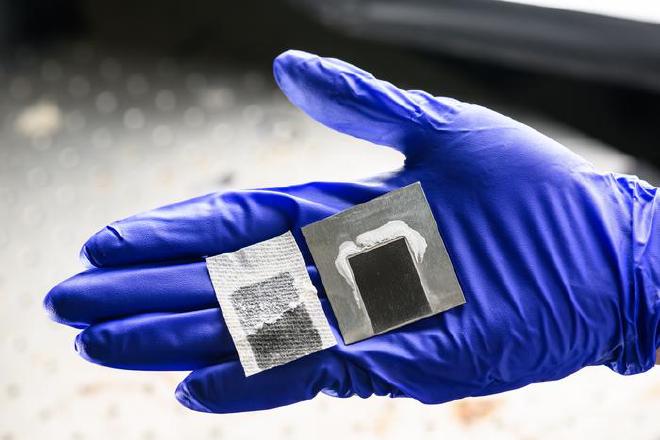
To keep their solar panel surface from gumming up in a similar way, Guo’s team precisely etched the black metal’s grooves so the various salts and minerals in ocean water would simply slough off. They also leveraged a physical phenomenon that has plagued clumsy javaphiles for centuries: the coffee ring effect.
“If you drop coffee on a surface, eventually the water evaporates and there’s a ring left at the outer edge that is the concentrated coffee particles,” says Guo. “We use that same principle to advance the salts to the passive region.”
Turning waste into resources #
One of the new method’s distinct advantages is that instead of leaving behind brine that must be disposed of or processed, it extracts nearly 100 percent of the salts in solid form. This could not only produce an abundant supply of table salt, but it could also be used to extract more precious minerals, including lithium, which is used in the lithium-ion batteries that power electric vehicles and other electronics.
In a related paper in the Journal of Materials Chemistry A, Guo and his colleagues show how they can use the same superwicking solar panels to separate lithium from the rest of other salts in desalination. Embedding nanoparticles made of hydrogen titanate in the tiny grooves of the black metal surface isolates the lithium from other salts and minerals.
Using water samples from Great Salt Lake, the researchers were able to extract about 50 percent of the lithium from the salts left behind by the desalination process.
Funding #
The research was supported by the US National Science Foundation, the Bill & Melinda Gates Foundation, and Worldwide Universities Network. Guo’s colleagues from the Institute of Optics who contributed to the research include Senior Scientist Subash Singh, alumnus Ran Wei ’24 (PhD), PhD students Luheng Tang and Tainshu Xu, and Mingjiang Ma.
Citation #
-
The article Additive-free and brine-discharge-free solar-thermal desalination with simultaneous complete mineral mining from ocean water was published in Light Science & Applications
-
The article New method turns ocean water into drinking water, without waste signed by Luke Auburn | Director of Communications, Hajim School of Engineering & Applied Sciences, was published in the URochester’s news section
Contact [Notaspampeanas](mailto: notaspampeanas@gmail.com)