Observaron el proceso de fusión que dio origen a las galaxias más masivas del Universo
·5 mins·
Notaspampeanas
Astronomía
Telescopio Espacial James Webb
Galaxias
CONICET
Victoria Reynaldi
Instituto De Astrofísica De La Plata
TGSS J1530+1049
Autor
Notaspampeanas
Notaspampeanas
Tabla de contenido
Tabla de contenido
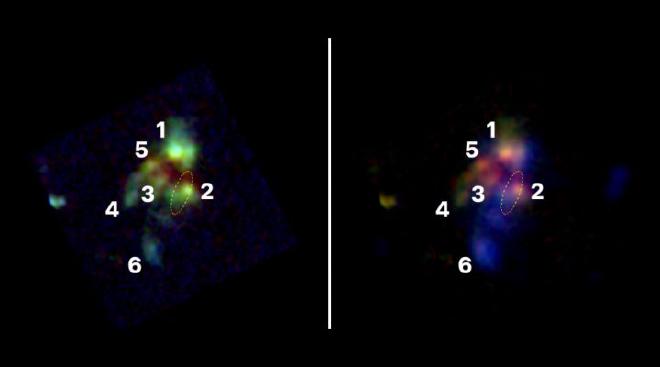
Un equipo internacional de astrónomos logró observar lo que podría ser una de las primeras etapas de la formación de las galaxias más masivas del Universo. Gracias a imágenes obtenidas con el Telescopio Espacial James Webb (JWST), los investigadores descubrieron que el objeto conocido como TGSS J1530+1049, que se halla a una distancia tal que lo vemos en el pasado, cuando el Universo tenía menos de 2.000 millones de años –apenas el 10 por ciento de su edad actual, 14 mil millones de años–, está compuesto por varias galaxias enormes que interactúan entre sí y que probablemente terminarán fusionándose en una sola estructura gigantesca.
A la izquierda, en tonalidad verde, las galaxias detectadas. A la derecha, las estructuras de gas en color azul. La número 2 es la radiogalaxia identificada. Crédito de la imagen: James Webb Space Telescope.
El hallazgo que fue reflejado en dos trabajos científicos publicados en las revistas Open Journal of Astrophysics y Astronomy & Astrophysics, contó con la participación de la investigadora del CONICET Victoria Reynaldi, quien se desempeña en el Instituto de Astrofísica de La Plata (IALP, CONICET-UNLP).
TGSS J1530+1049 había sido identificado originalmente como una posible radiogalaxia, un tipo especial de galaxia que, a diferencia de las normales –que brillan por la luz de las estrellas, el gas y el polvo que las componen–, emite una inusualmente intensa radiación en ondas de radio de origen diferente: estas emisiones suelen estar asociadas a la presencia de un agujero negro supermasivo en su núcleo –por eso se las conoce como galaxias activas o de núcleo activo–, que acumula grandes cantidades de materia y libera muchísima energía en todo el espectro electromagnético, es decir en todo tipo de radiación (luz visible; infrarrojo, ondas de radio), lo que en ocasiones hace que se produzcan jets o emisiones con velocidades cercanas a la de la luz. Si bien este objeto era un candidato a radiogalaxia, hasta ahora no se había podido confirmar con precisión su naturaleza.
Victoria Reynaldi. Crédito de la imagen: Victoria Reynaldi.
Las imágenes obtenidas por el James WwebSpace Telescope pudieron confirmar esa premisa, pero revelaron una realidad mucho más compleja de lo esperado: lo que parecía una única radiogalaxia resultó ser un conglomerado formado por al menos diez objetos diferentes, agrupadas en dos conjuntos con características distintas, según la radiación que emiten: “Un grupo presenta propiedades típicas del medio interestelar, es decir son estructuras dominadas por radiación proveniente del gas”, puntualizó Reynaldi. “En el otro grupo hay seis galaxias que están dominadas por la luz de las estrellas que las componen”, añadió. Y, una de ellas, fue identificada como la galaxia activa de la que proviene la emisión en ondas de radio detectada originalmente, con lo que se pudo comprobar que en el complejo TGSS J1530+1049 hay una radiogalaxia.
Sin embargo, el hallazgo más revelador fue la determinación que varias de esas galaxias poseen masas extremadamente elevadas y se encuentran muy próximas unas de otras. A pesar de que fueron observadas en una época muy temprana de la historia cósmica, ya habían formado una enorme cantidad de estrellas y continuaban haciéndolo a una velocidad extraordinaria y más eficientemente que las que nos rodean actualmente: mientras que la nuestra, la Vía Láctea, produce actualmente de tres a cinco estrellas similares al Sol por año, algunas de estas galaxias generan anualmente más de 100. “Cuatro de las más masivas están ubicadas en un área que si se delimitara un cuadrado, sus lados serían apenas un poco más grandes que la distancia que separa al Sol del centro de la Vía Láctea”, graficó Reynaldi.
La proximidad entre estos sistemas indica que están interactuando gravitacionalmente y que, con el tiempo, terminarán fusionándose. Ese proceso dará origen a una galaxia mucho más grande, comparable con las gigantes que hoy ocupan el centro de los cúmulos de galaxias y que se encuentran entre los objetos más masivos y luminosos del Universo.
“Estamos ante resultados muy excitantes que ponen a prueba las teorías actuales sobre la formación de galaxias en el Universo temprano”, apuntaron desde el IALP. “Según ellas, estas estructuras colosales debieron haberse generado a partir de otras menores, pero este proceso no se había observado de manera directa hasta ahora. Como en esas etapas tempranas los cúmulos de galaxias aún no estaban formados, las conclusiones de este trabajo indican que muy probablemente estemos viendo el espectacular proceso de fusión mediante el cual nacen las galaxias más masivas del Universo”, concluyeron.
Saxena, A.; Overzier, R.; Aydar, C.; Lyu, J.; Rieke, G.H.; Reynaldi, V.; Villar-Martín, M.; Gabányi, K.; … & Venemans, B. (2026). JWST observes the assembly of a massive galaxy at z~4. Open Journal of Astrophysics, 9. DOI: https://doi.org/10.33232/001c.159461
Gabányi, K. É., Frey, S., Gurvits, L. I., Paragi, Z., Perger, K., Saxena, A., … & Mező, G. (2026). High-resolution radio imaging of TGSS J1530+ 1049, a radio galaxy in a dense environment at z= 4. Astronomy & Astrophysics, 710, A20. DOI: https://doi.org/10.1051/0004-6361/202558162
El artículo Observan cómo es el proceso de fusión de galaxias que dio origen a las más masivas del Universo fue publicado hoy en el sitio web del CONICET.