


La sonda Psyche de la NASA sobrevoló Marte el 15 de mayo, aprovechando la gravedad del planeta para ganar velocidad e inclinar ligeramente su trayectoria. Este sobrevuelo también brindó al equipo la oportunidad de prepararse para la investigación científica que realizarán al llegar al asteroide Psyche, rico en metales, en 2029.
Este vídeo time-lapse muestra la aproximación, el acercamiento máximo y la partida de la sonda espacial Psyche de la NASA en Marte, mientras utilizaba la gravedad del planeta para impulsarse en su camino hacia el asteroide Psyche. Créditos: NASA/JPL-Caltech/ASU/True Story Films
Utilizando Marte como sustituto del asteroide durante el sobrevuelo, pudieron probar los instrumentos científicos de la nave espacial. Los resultados, transmitidos y analizados durante las semanas siguientes, fueron impresionantes. Los instrumentos no solo funcionaron con precisión, proporcionando datos que coinciden con lo que la NASA ya sabe sobre Marte, sino que también aportaron algunas ideas nuevas sobre el planeta.
Este vídeo presenta al equipo responsable de las labores de obtención de imágenes y calibración de instrumentos durante el sobrevuelo de Marte por la sonda Psyche de la NASA el 15 de mayo de 2026. La nave espacial aprovechó el campo gravitatorio del planeta para obtener un valioso impulso, pero también pudo realizar algunas investigaciones científicas en el trayecto. Créditos: NASA/JPL-Caltech/ASU/True Story Films
Salpicado por neutrones de Marte #
Si bien la altitud de sobrevuelo de 2.864 millas (4.609 kilómetros) era demasiado grande para medir los rayos gamma provenientes de Marte, los científicos tenían enormes esperanzas de que se pudieran detectar los neutrones que escapaban de la superficie y la atmósfera del planeta.
Marte magnético #
Al igual que el espectrómetro de rayos gamma y neutrones, el magnetómetro de la misión ha estado en funcionamiento desde que la nave espacial inició su viaje con su lanzamiento en 2023. Diseñado para medir el campo magnético del asteroide Psyche, el instrumento ayudará a la misión a comprobar la hipótesis de que el objeto es el núcleo metálico de un planetesimal, un componente básico de un planeta rocoso.
Si bien el instrumento ha estado midiendo constantemente el campo magnético del viento solar durante la trayectoria de crucero, incluso cuando ocasionalmente se produjeron eyecciones de masa coronal que impactaron la nave espacial, esta es la primera señal de campo magnético de un cuerpo celeste que ha medido el magnetómetro de la sonda.
Imágenes del Planeta Rojo #
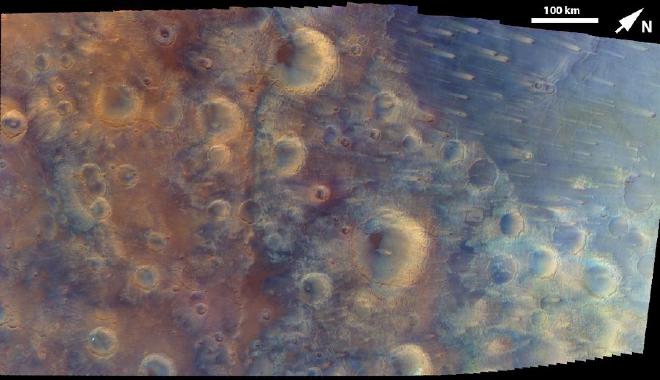
Desde principios de mayo y durante todo el sobrevuelo, el generador de imágenes multiespectral de la sonda espacial —un par de cámaras idénticas diseñadas para fotografiar la superficie del asteroide en diferentes longitudes de onda de luz— había estado enviando imágenes de Marte al flujo de imágenes sin procesar de la misión. Debido al elevado ángulo de fase con el que la nave espacial se aproximaba al planeta, Marte apareció inicialmente como una media luna delgada y brillante, con la luz solar dispersándose a través de su atmósfera.
Durante el acercamiento, el equipo de imágenes capturó vistas detalladas de la superficie marciana, incluyendo cráteres formados por el viento, el casquete polar sur y el gran cráter Huygens de doble anillo. Todos ellos son visibles en un vídeo a cámara rápida que recoge la secuencia de imágenes del sobrevuelo, que duró un mes.
Para ayudar a caracterizar y calibrar el generador de imágenes, el equipo está comparando las imágenes de los sobrevuelos con datos de imágenes de otras misiones en Marte, incluyendo el Mars Reconnaissance Orbiter de la NASA, el orbitador Mars Odyssey que arribó en 2001 y las exploradoras robóticas Curiosity y Perseverance, junto con el Mars Express y el ExoMars Trace Gas Orbiter de la ESA (Agencia Espacial Europea), y el Hope Orbiter de la Misión a Marte de los Emiratos Árabes Unidos.
“Esta asistencia gravitatoria se gestó durante años, y el equipo de navegación lo logró a la perfección: Psyche sobrevoló Marte siguiendo la trayectoria exacta que necesitábamos para encaminarnos hacia el encuentro con el asteroide en el verano de 2029”, declaró Bob Mase, director del proyecto Psyche en el Laboratorio de Propulsión a Chorro de la NASA en el sur de California. “La sonda espacial se encuentra en excelentes condiciones y estamos cumpliendo con el cronograma previsto para reanudar el impulso sostenido con el sistema de propulsión solar-eléctrica a finales de otoño”. (Recordemos que el otoño en el hemisferio norte de la Tierra comienza a mediados del mes de septiembre)
La sonda espacial Psyche se dirige ahora directamente hacia su asteroide objetivo, situado en el cinturón principal de asteroides entre Marte y Júpiter.
Contacto [Notaspampeanas](mailto: notaspampeanas@gmail.com)