


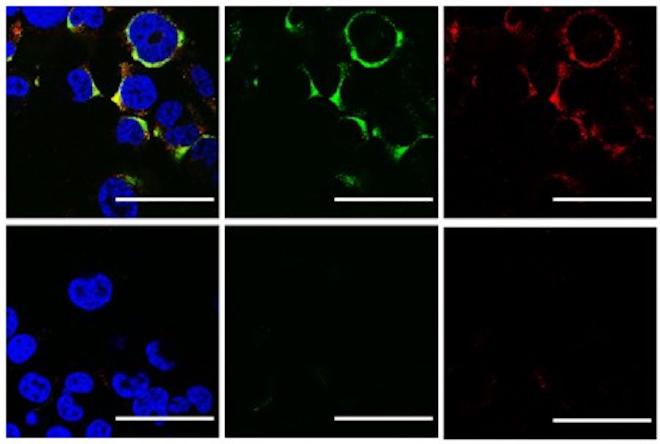
“It’s kind of like fighting the virus with a shout. In this study, we proved that the energy of sound waves causes morphological changes in viral particles until they explode, a phenomenon comparable to what happens with popcorn. By degrading the structure of the pathogen, the protective membrane of the virus [called the envelope] bursts and deforms, preventing the virus from invading human cells,” explained Odemir Martinez Bruno, a professor at the São Carlos Institute of Physics (IFSC) at USP who coordinated the study.
“Although it’s still far from clinical use, this is a promising strategy against enveloped viruses in general, since developing chemical antivirals is complex and yields difficult results. Furthermore, it’s a ‘green’ solution, as it generates no waste, causes no environmental impact, and doesn’t promote viral resistance,” said Flávio Protásio Veras, a professor at the Federal University of Alfenas (UNIFAL) and a FAPESP postdoctoral fellow. FAPESP funded the work through projects 20/05601-6, 23/07241-5, 13/08216-2, 19/26119-0, 18/22214-6 and 21/08325-2.
The initiative also benefited from the collaboration of Charles Rice, a professor at Rockefeller University in the United States and the 2020 Nobel Prize winner in medicine. Rice provided fluorescent viruses for real-time visualization.
It’s the geometry #
The discovery surprised the researchers because it contradicts classical physics theories, as the wavelength of ultrasound is much longer than the size of the virus. In theory, this difference in size would prevent interaction.
He also points out that since the process depends strictly on the shape of the viral particle and not on genetic mutations, variants such as those observed during the pandemic (Omicron and Delta, for example) do not affect the effectiveness of the technique.
Frequency adjustment #
“The technique isn’t intended for decontamination. That already exists. Ultrasound is already used to sterilize dental and surgical equipment, but it works through a different physical phenomenon called cavitation, which destroys biological material,” Bruno said.
He explained that acoustic resonance and cavitation differ mainly in the frequency used and their effects on viruses and cells. “While cavitation occurs at low frequencies and destroys both viruses and tissues through the collapse of gas bubbles, acoustic resonance operates at high frequencies [3–20 MHz],” he noted.
https://agencia.fapesp.br/57968
Another scientific article published in the Brazilian Journal of Physics describes the theoretical basis behind the phenomenon of popping enveloped viruses like popcorn.
Citation #
-
The study Ultrasound effectively destabilizes and disrupts the structural integrity of enveloped respiratory viruses, was published in en Scientific Reports. Authors: Flavio P. Veras, Gilberto Nakamura, Marcelo A. Pereira-da-Silva, Gilia C. M. Ruiz, Carlos J. L. Constantino, Ronaldo Martins, Eurico Arruda, Fernando Q. Cunha & Odemir M. Bruno
-
The article Scientists use ultrasound to destroy influenza A and COVID-19 viruses without damaging human cells, signed by Maria Fernanda Ziegler was published in Agência FAPESP’s website
Contact [Notaspampeanas](mailto: notaspampeanas@gmail.com)