


En un artículo publicado hoy en el sitio web de la Universidad Johns Hopkins, con la firma de Jill Rosen, podemos leer que más del 70% de los estadounidenses sostienen el derecho a interactuar con un humano en lugar de con una IA en entornos médicos, legales, educativos y gubernamentales. Esta propuesta de regulación y otras fueron respaldadas a través de las líneas partidistas y tanto por usuarios habituales de IA como por principiantes.
En abril y mayo, a más de 2.000 personas en Estados Unidos se les preguntó su opinión sobre la inteligencia artificial. Las preguntas exploraron cómo se sentía generalmente la gente respecto a la tecnología, cuánto confiaban en ella en entornos personales y laborales, y sobre su apoyo a nuevas leyes que se estaban considerando en todo el país.
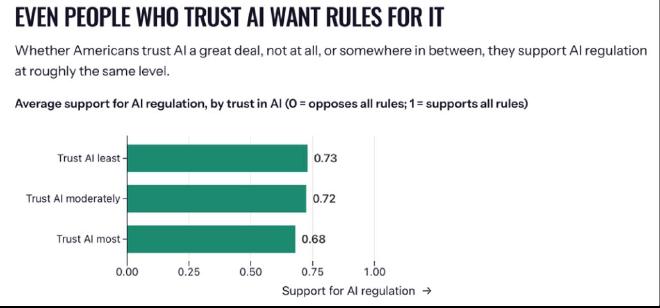
Republicanos y demócratas sentían algo similar respecto a esta tecnología.
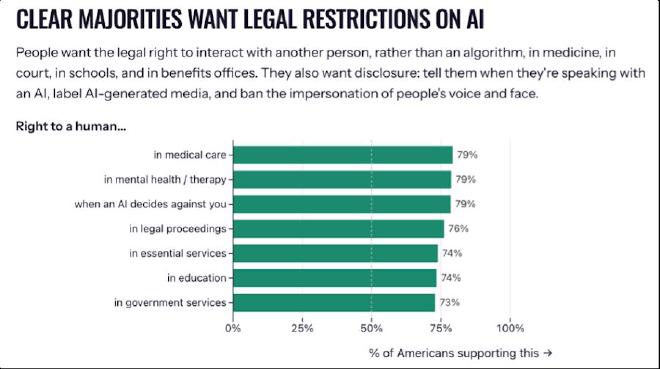
Los estadounidenses también apoyan firmemente más normas para proteger su privacidad y hacer que la IA sea más transparente:
-
El 75% quiere que les digan cuando interactúan con IA
-
El 73% quiere prohibir que la IA use las caras y voces de las personas
-
El 68% quiere etiquetas en imágenes y vídeos generados por IA
Los estadounidenses confían más en la IA para ciertas tareas que en otras:
-
Búsqueda de información fáctica: el 67% confía en la IA en cierta medida o mucho
-
Presentación de la declaración de impuestos: el 42% confía en ello en cierta medida o mucho
-
Crear arte o componer música: 57% confía en ello en cierta medida o mucho
-
Que sea una compañera de trabajo: el 32% confía en esto en cierta medida o mucho
-
Gestionar la jubilación: 33% confía en ello en cierta medida o mucho
-
Brindar asesoramiento médico: 63% no confía mucho o en absoluto
-
Enseñanza en el nivel secundario: 69% no confía mucho o en absoluto
-
Decidir en un caso judicial: 81% no confía mucho o nada
-
Conducir un automóvil: 76% no confía mucho o nada
A medida que la IA avanza, alrededor de cuatro de cada diez estadounidenses esperan que las grandes empresas tecnológicas obtengan las mayores ganancias en potencia. Menos de 1 de cada diez espera que los individuos obtengan más poder. Y casi 1 de cada 5 estadounidenses piensa que serán los propios sistemas de IA.
“Nos interesaba escuchar la voz nacional mientras el público intenta comprender estos problemas. ¿Qué piensa y siente la gente?” sobre la inteligencia artificial", dijo Rolando Masís-Obando, neurocientífico computacional de Johns Hopkins que utiliza IA para estudiar cómo piensa y recuerda la gente. “Estamos tomando el pulso de la nación con esta encuesta, y queremos publicarla cada año para ver cómo cambian las opiniones con el tiempo”, dijo.
Los hallazgos completos y la metodología pueden encontrarse en futurerealities.org. Los resultados serán presentados y se debatirán en la conferencia The Future of Our Realities 2026 el 20 de junio en el Hopkins Bloomberg Center en Washington, D.C.
Cita #
El texto y los cuadros informativos pertenecen a la Universidad Johns Hopkins. Además de la traducción del inglés al español, en Notaspampeanas sólo añadimos la fotografía de Geralt publicada en Pixabay.com. ¡¡¡Muchas gracias, Geralt!!!
Contacto [Notaspampeanas](mailto: notaspampeanas@gmail.com)